Tuesday, 29 October 2019

The Sweat Money

Managers of the Rs 4300 crore Provident Fund of the workers in Jammu and Kashmir’s private and public sector were literally yearning for a change that would help improving social security to its members. Now the takeover of the Fund by the Central EPFO will completely change the systems and take the Fund to the next level, reports Masood Hussain
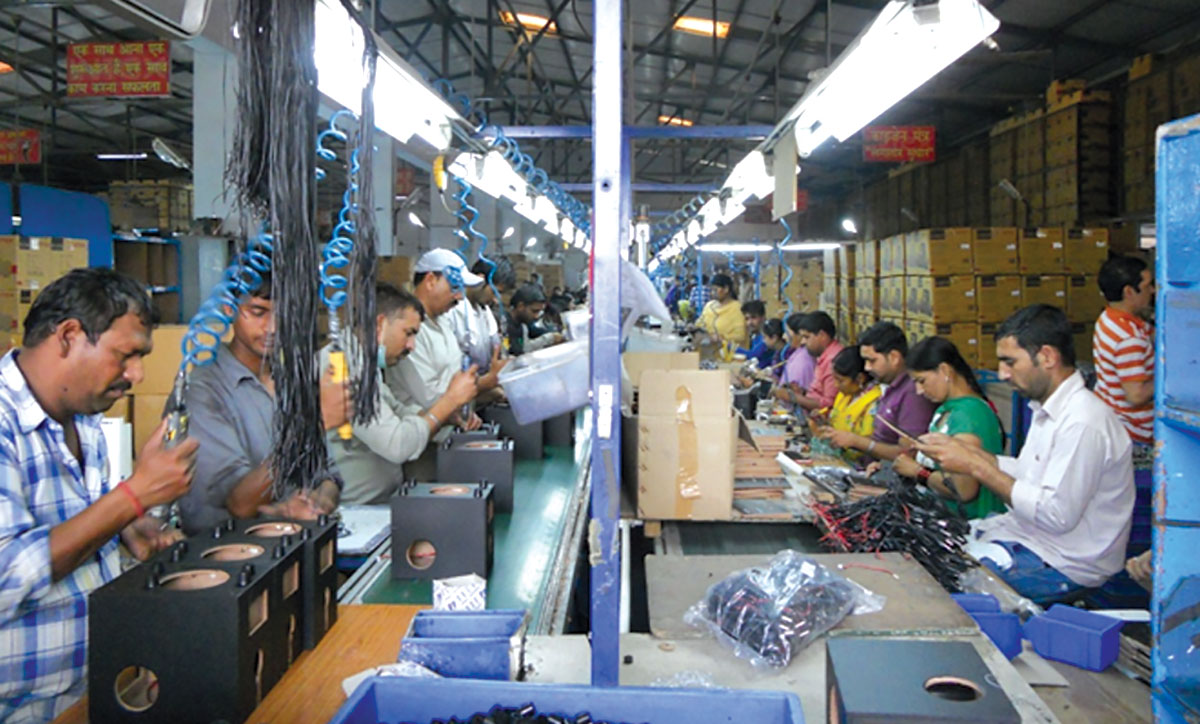
A group of employees of a private company during their working hours.

A group of employees of a private company during their working hours.

Financial and job security has remained the key element for the people in conflict-ridden and turmoil-hit Jammu and Kashmir to get into the government. State’s location and a small population has always remained a major drawback in creating a vibrant manufacturing sector. Even the best concessions by the government have not been able to reverse the trend.

But Jammu and Kashmir still has an impressive manufacturing sector. In fact the services sector is so vibrant that it has already overtaken the primary and the secondary sectors of the state economy. Despite its small size, the private sector in Jammu and Kashmir still employs more than two-third of what the central and the state government’s employ in the soon-to -be Union Territory. But the workers lacked a better social security.

J&K’s Employees Provident Fund Organisation (EPFO) was the sole authority to regulate and implement a number of state and central labour laws. The statutory organisation with its officials having quasi-judicial powers was set up in 1961 and operated within the Labour and Employment department. Welfare of entire private sector and the state-owned Public Sector Undertakings (PSU) is solely managed by EPFO.

Officials manning the EPFO said that by the end of October 2017, they had registered more than 16000 establishments for the provident fund collection with a cumulative number of around 511000 workers. It excludes thousands of workers working with various private banks, constructions companies and other multi-national companies, which operate in the state. The EPFO has presence in 11 of state’s 22 districts. Most of the registered workers are from the manufacturing sector, mostly from Jammu, Samba and Kathua. Kashmir has less than 1.5 lakh workers registered with the EPFO.

One of the major activities of the EPFO has remained the collection and managing the provident fund that the listed workers and their employees (offering 12 per cent of the basic salary, each) are jointly parking on monthly basis with the organisation. This is the main kitty and the main activity of the EPFO.

“Right now, we have a corpus of Rs 4300 crore with us,” a senior executive of the EPFO said. “Under the law of the land we have to pay 8.5 per cent on interest on the saving to the subscribers.” The entire corpus is converted into FDs and parked with the state government owned J&K Bank.
EPFO - employees Provident Fund Story

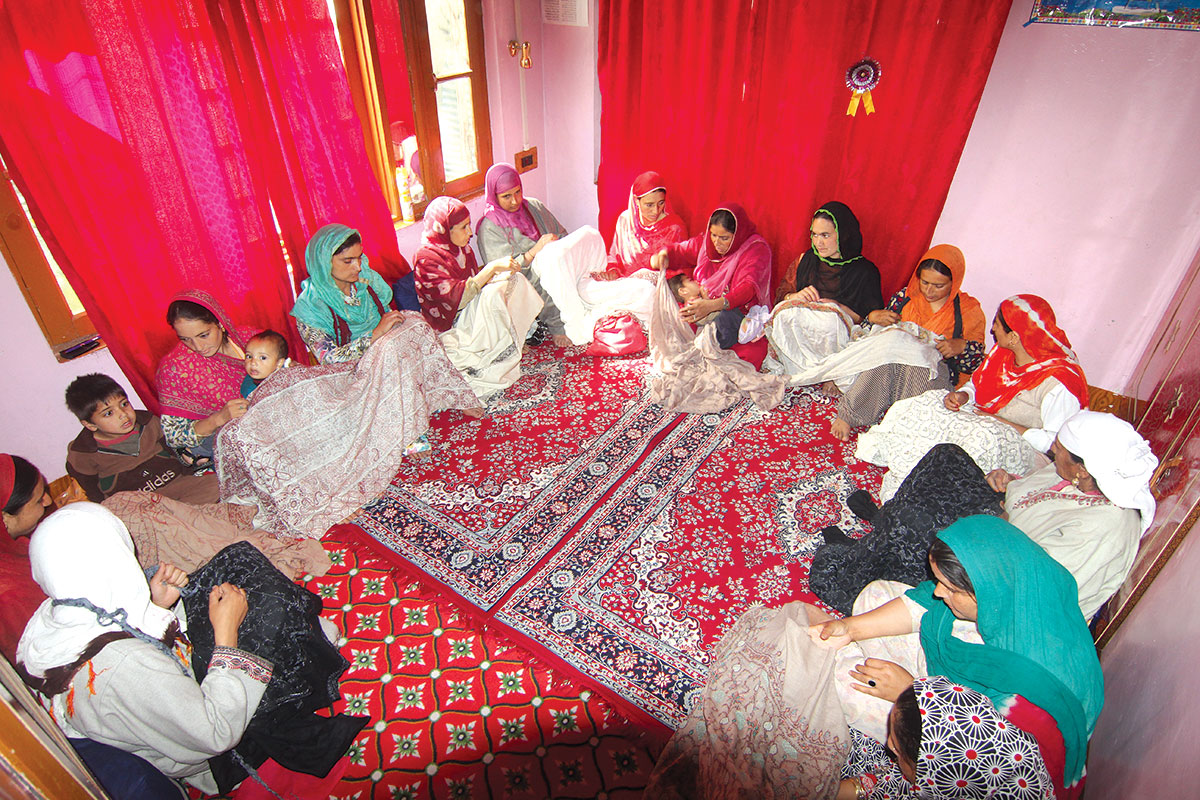
Women doing needle work. KL Image by Bilal Bahadur

The kitty yield is changing on almost daily basis as subscribers reclaim their savings or seek advances to manage their affairs. In fiscal 2016-17, officials said they settled as many as 21087 cases – involving both maturity and advances (5375 cases), and it involved an outgo of Rs 156 crore. In the same year, the contributions that have come to the kitty were at Rs 325 crore.

In 2017-18, the EPFO settled 30190 cases that led to the outgo of Rs 224.11 crore. The year also witnessed new contribution of Rs 417 crore coming to the Fund. In fiscal 2018-19, the EPFO settled 28786 cases and disbursed Es 257.82 crore. But the year saw a huge sum of Rs 483 crore coming as the new contribution.

But the Fund was facing a serious crisis. In the last few years, the yield on deposits nosedived as the rate of interest that the banks are offering was steadily falling. It has gone down from 8.45 per cent to 6.25 per cent now.

After losing almost Rs 170 crore till 2017-18, the EPFO finally got into negotiations with the Jammu and Kashmir Bank. “The bank agreed that they will be paying us an interest of 8 per cent, and even with this rate, we are losing 0.5 per cent of interest,” a senior executive said. “We are negotiating an investment pan with the bank and if that is finally taking place, we will get a yield of 10.5 per cent on part of the Fund we have but the deal has not been concluded yet.”

In order to offset the losses, the EPFO has been busy in considering many options to improve the earnings. A committee was actually looking into the issue. An option being strongly supported by various policymakers even before the August 5, was that J&K EPFO can have some relationship with the central EPFO. It was because the Government of India’s EPFO is managing a corpus of Rs 7.5 lakh crores and it has dedicated investment division that helps it make quick decisions and the fund earns better. Central EPFO has a payout rate of 8.6 per cent and has never dropped.

The other major benefit of having an alliance with the central EPFO was that it will broaden the base. Employees of the MNCs, private banks and various companies operating in the state were not registering its employees with the J&K’s EPFO because of limited benefits. Subscribers to the EPFO in J&K also lacked the facility of portability and a universal identity (account number) that dwarfed its status in comparison to other major funds.

The official committee was exploring the options for better earnings that the August 5, decision repealed the law that was governing the J&K EPFO. Now, the decision will have to be taken in coming days after the future of EPFO. “Will it be a separate entity or will be taken over by the Central EPFO remains to be seen,” one executive said. “The fact is that a number of meetings have taken place between the state government and the Central EPFO.”

The EPFO has been implementing the Employees Deposit Link Insurance (EDLI) scheme for the private sector employees. Operational since 2000, the EPFO was taking one per cent of the wages of the employee from the employer as premium on monthly basis. If the worker dies or meets an accident, he used to get a maximum of Rs 75,000.

The EPFO later took the pay-out to Rs 2 lakh. And now the new situation has emerged under which this pay-out will go to Rs 6 lakh.

In 2016-17, EPFO received an amount of 9.98 crore as premium for EDLI. It was Rs 12.83 crore in 2017-18 and Rs 14.35 crore in 2018-19.

What was interesting, however, was that the organisation had linked it to the death. It does not offer anything to an employee if he retires. Where the premium for the insurance that an employer has been paying for the enter service career of the employee goes? There are better schemes in market that will get a substantial sum to the beneficiary on the same premium, in both the cases.

The third major account that the EPFO is maintaining is the administrative charge. It is the most interesting one. Employers in private sector were bound by the now repealed law to pay EPFO five per cent of the total PF outgo in a month to maintain the fund.

This is the main bread and butter of a state organisation that is being run by 120 employees, has quasi-judicial authority on labour issues. In 2016-17, the private sector contributed an amount of Rs 17.65 crore to the EPFO as administrative charges. This tax reached Rs 22 crore in 2017-18 and Rs 25 crore in 2018-19. Interestingly, the EPFO wage bill for a year is Rs 11 crore only. Officials said it has reached Rs 18 crore.

So the sole profit maker was the EPFO itself. It was saving on this count. Right now, the EPFO has Rs 90 crore as saving from this account alone.

This “tax” made EPFO as the only organisation in Jammu and Kashmir that was fully paid, almost in access to its requirements, by the private sector. Ideally the administrative charges on the fund are a penal tax on the employer and should have been borne by the government because it has an inherent vested interest to encourage private sector.
EPFO - employees Provident Fund Story

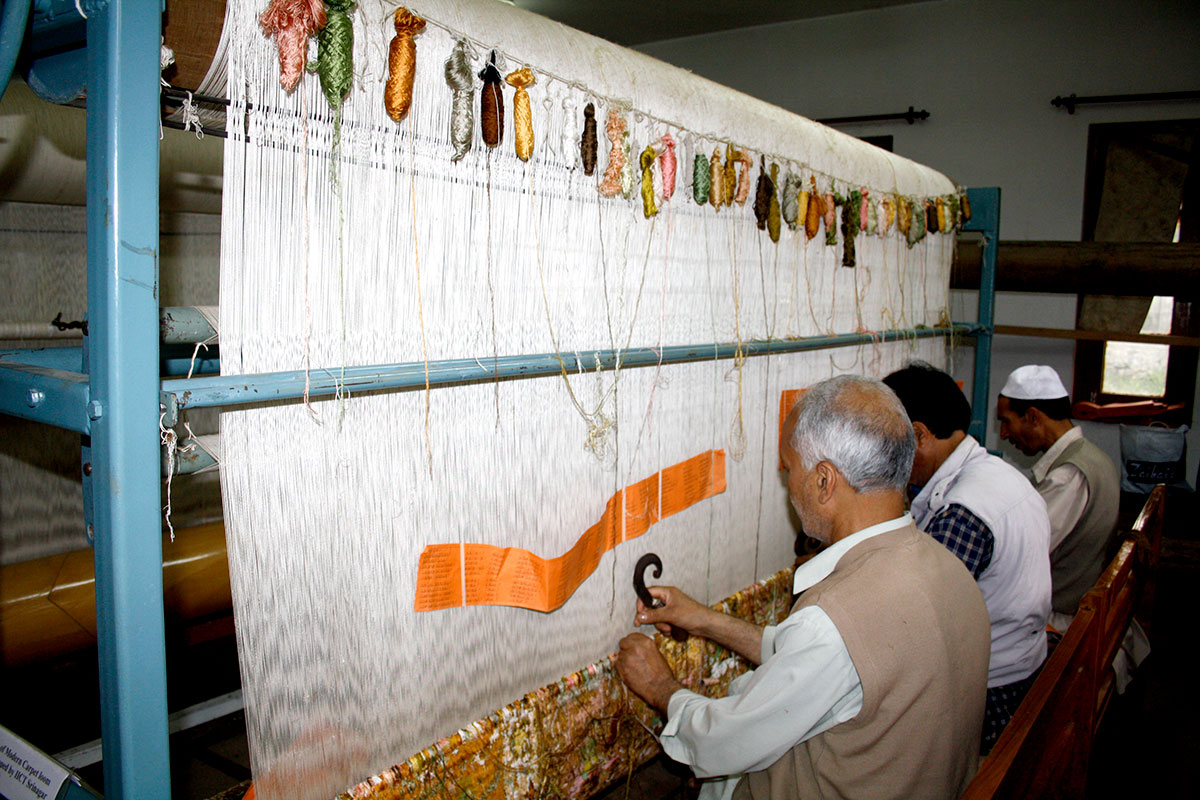
Men busy with carpet weaving.

Understanding the crisis, the government in 2015 announced reducing the administrative charges by two per cent. Interestingly, after being passed by the assembly, the EPFO binned the decision.

The other fact of the welfare bogey was interesting. While the government was literally squeezing the private sector, it is enjoying autonomy in denying the same benefit to tens of thousands of employees who are outside the government’s provident fund and pension system. Officials in the EPFO said the J&K government employs nearly 70,000 employees in 22 organisations in which the workers have no welfare benefit. It starts with NRHM and ends with ICDS. The government is skipping getting these casual and contractual employees into the ambit of EPFO because it will add to its costs. Normally the law is that anybody who employs more than 10 workers has to be registered with the EPFO. Some labour department officials have formally fined some top executives for this crisis but they pleaded in the court that the government has not offered them budgetary support for subscribing the policies for their staff.

Now the situation is bound to change. Since the central labour laws would govern the state directly, the central EPFO will extend its schemes to the state.

Now, the employers will pay only 0.5 per cent as administrative costs against the prevalent 5 per cent. For deposit linked, the employers will pay 0.5 percent, half of the rate in vogue.

Under the Central EPFO, now subscribers having 10 year PF contributions will make them entitled to some kind of post-retirement pension. In case of death, the dependents will have some benefits also. Jammu and Kashmir’s EPFO lacked this facility but was keen to ally with the big brother to have it. Central EPFO pays at 8.65 per cent.

“This all is still in fluid,” one EPFO officer said. “The fact is that the law that governed us is repealed. Now it remains to be seen how this organisation will run in coming days, I think by November, we will have a clear idea.”


from Kashmir Life https://ift.tt/32UashW
via IFTTThttps://kashmirlife.net

BJP’s New Tensions

Though the elections for the local bodies and Panchayats were considered a hugely partial exercise, at least in Kashmir, the outcome of the just concluded BDC polls indicated the BJP’s slide in Jammu and Kashmir politics, reported Muhammad Younis

BDC-ELECTION-(3)

There are two striking facets to the elections of the Block Development Councils (BDC) that took place in absence of the major stakeholders of the Jammu and Kashmir’s politics. These councils are the mandatory second- tier to the Panchayati Raj System of which the Panchayat is the basic unit. It still would require the constitution of District Development Councils as the final-tier of the system.

First, the governor’s administration failed to ensure the participation of all the voters (Panchs and Sarpanchs) despite the fact that they have been living in protection of the police ever since a sham exercise elected them to their position in 2018 fall. Second, the BJP that had literally a clean chessboard – the only opposition being the Udhampur based National Panthers’ Party (NPP), could not had a clean sweep even in Jammu.

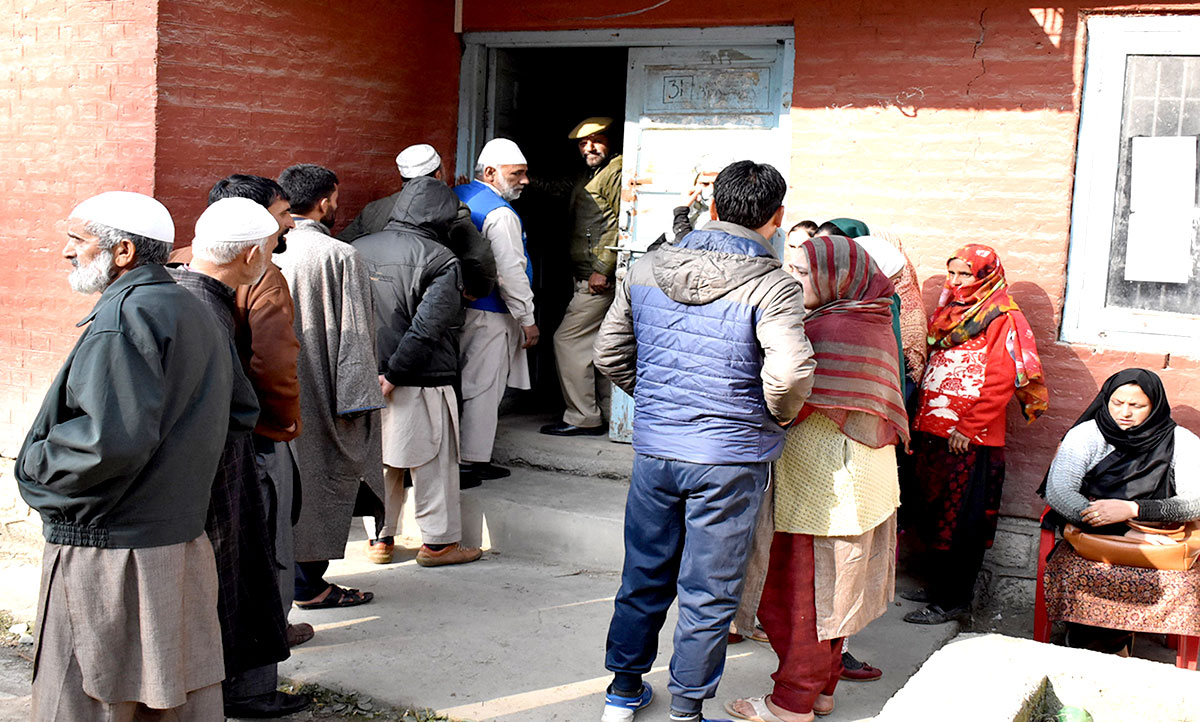
Jammu and Kashmir has 316 BDCs.  In six, elections were not held, and at three BDCs, the nominations were found invalid. Besides, at 27 BDCs, the chairmen were elected unopposed. This left 280 to go to polls on October 24, the results of which were declared the same evening. Election was held for 148 Councils in Jammu, 128 in Kashmir and 31 in Ladakh. A total of 26629 Sarpanchs and Panchs – 8313 of them women – comprised the election’s electoral college and 1065 candidates were in the fray. The voters, in Kashmir, were driven from their highly secured hotels in buses by the government to their respective polling stations for voting.

Shailendra Kumar, Jammu and Kashmir’s Chief Electoral Officer (CEO) said of these 307 BDCs, BJP captured 81, Congress one, NPP eight (all in Udhampur) as independents have 217. Kumar said BJP won 52 Councils in Jammu, 18 in Kashmir and 11 in Ladakh. Congress bagged lone Council in South Kashmir’s Pulwama district. As many as 109 independents won in Kashmir followed by 88 in Jammu and 20 in Ladakh.

Nobody knows who the independents are. But a general perception is that they belong to NC, PDP and Congress. In a way, this is embarrassing as the governor’s administration has kept NC and PDP leadership under lock and key since August 5, and the two main parties have stayed away from the entire Panchayat exercise since 2018.

However, a cursory look at the BDC results indicates the BJP performance shows the same trend in an indirect poll in Jammu and Kashmir as the direct elections in assembly polls in Haryana and Maharashtra exhibited – a gradual decline.

BJP had fielded 135 candidates in Jammu region but only 52 candidates won. In the 2014 Assembly elections, BJP had emerged as the single largest party from the state’s Jammu region with 25 seats. The party had also swept the 2014 Lok Sabha polls which marked the ascension of Narendra Modi as India’s prime minister. In the 2019 Lok Sabha polls, the party had repeated its winning streak by winning all the three parliamentary constituencies of Jammu division.

In state’s main Hindu belt – Jammu, Kathua, Samba, and Udhampur, the saffron party’s performance is unimpressive. From the state’s Hindu dominated region, the mainstay of BJP politics, the party could secure only 53 berths out of the total 148 seats. Of the 20 BDCs in Jammu district, it got only nine. In Samba, it got four out of nine; nine out of 19 in Kathua; and only 4 out of 17 in Udhampur.

In contrast, it was slightly better in districts with mixed populations in Jammu region: BJP got 7 out of 13 in Kishtwar, 5 out of 17 in Doda, 2 out of 11 in Ramban, 4 out of 12 in Reasi, and 8 out of 19 in Rajouri. Poonch is the only district where it could not cut ice in any of the 11 BDCs.

“The party candidates even lost in the home blocks of all senior leaders, allegedly due to infighting, including that of state president Ravinder Raina where the opposition “supported” independents emerged victorious,” The Tribune reported. “The BJP even failed to win any seat from the Nagrota Assembly segment which is the home constituency of the sitting LokSabha member Jugal Kishore Sharma.”

The newspaper reported that the BJP’s worst came from the home district of its vocal state president Ravinder Raina who even lost his home block of Lambari.

The situation for the party is quite grim in Ladakh, the arid region that got Union Territory because of BJP. In Leh, BJP got 7 out of 16, and in the neighbouring Kargil, it won only 4 out of 15.

Ladakh and Jammu are the two region that hugely participated in the Panchayat polls unlike Kashmir where parties as well as people boycotted the exercise.

In Kashmir, BJP had fielded 60 candidates and 18 of them won. But 12 of them were from Pulwama and Shopian districts where most of the candidates in the fray were Kashmiri Pandits living as migrants in Jammu.

In Kashmir, most of south Kashmir stayed away to the extent that elections actually did not take place. Still, BJP could not do wonders. It was declared winner in 18 out of 128 BDCs in Kashmir. In Shopian’s nine BDCs, it could win eight because it failed to file any nomination in ninth council! In Kulgam, Kupwara, Bandipora, Ganderbal, and Srinagar, the party could not open an account, apparently for the same reasons. It, however, managed one of 26 in Baramulla, 2 of 17 in Budgam, 4 of 11 in Pulwama, and 3 of 16 in Anantnag.

This obviously indicated the party may talk about “changing the politics” of Kashmir but might be unable to hold any sway. It could not win a better share in an exercise that was visibly sham and without a competition. However, there is no information, if the party might be having like-minded in the independents’ flock.


from Kashmir Life https://ift.tt/332Md1a
via IFTTThttps://kashmirlife.net

Labour Deficit

In run-up to August 5, when the government issued advisory asking non locals to leave Kashmir immediately, tens of thousands of skilled and migrant workers left home. As the communication blockade prevented them to stay in touch with their employers, almost entire manufacturing facility suffered immensely, reports Shams Irfan

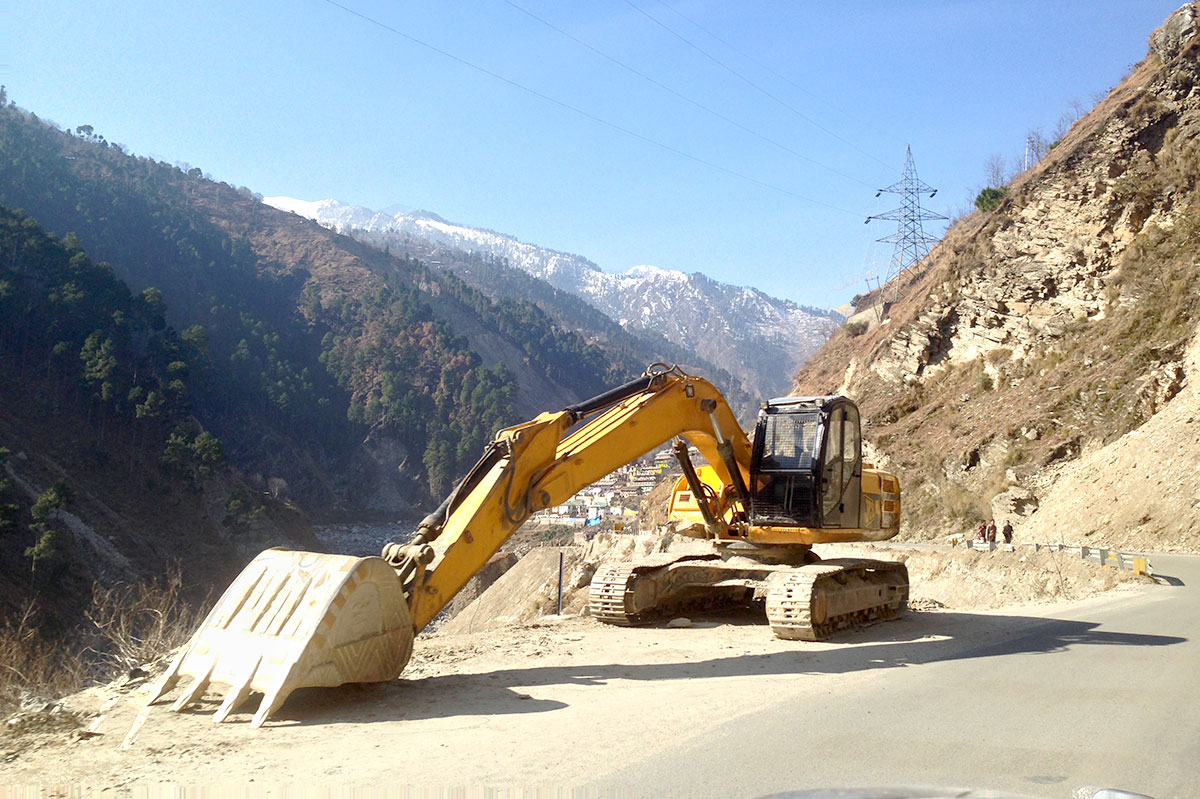
Labour Deficit Story - JCB -

On October 14 when mobiles phones started to ring again after 71 days of communication blockade, Abid Khan, 35, made his first call to his work’s supervisor Aman in Kolkata. It was a short but emotional call. The call was made to assure Aman that the situation has improved in Kashmir and he can now return along with his team of workers.

Khan, who owns a cardboard box manufacturing plant in Industrial Estate, Khunmoh, had to shut-down operations on August 3, after non-local workforce started to leave Kashmir en masse. “I convinced Aman and few other workers to stay back,” recalls Khan.

But on August 5, after the abrogation of Kashmir’s special status, Aman and other labourers became restless.  “So I let them go,” said Khan. “For the first time they started fearing for their lives in Kashmir.”

The same day, Khan locked down his manufacturing facility halting all operations. “I had an advance order for manufacturing of over five lakh apple boxes,” said Khan. “There was no possibility of any work.”

As apple-harvesting season was approaching fast, Khan invested his entire savings to meet the demand and deadline.

“When landline phones started to function, I rang Aman and asked him to keep labourers ready as I was sure things will be normal in a short while,” said Khan. “But I was proven wrong.”

Khan’s emotional call was one last effort to convince Aman to come back before apple season concludes.

But Khan is not the only one who has tried everything to convince labourers to come back. A number of factory owners lured their workers with gifts like new mobile phones, bonuses and other things to convince them back to work.

For Majeed, a young entrepreneur who owns a small food processing plant in Khunmoh, getting back skilled workers was like a herculean task for him.

“I had to talk to every single worker’s family, parents, wife, kids and convince them that they will be safe,” said Majeed, who managed to get his key workers back in early October.

In order to keep his workers happy after their return, Majeed promised them bonus on Diwali and an extra day’s holiday.

“I have made small space for my products in the market in last three years. Now, after staying shut for over two months I have lost my 70 percent market already,” said Majeed.

Majeed is sceptical that his workers will leave him any day forcing him to close his unit forever. “I tried to hire locals but they lack both expertise and urge to learn,” said Majeed sadly.

In Industrial Estate, Lassipora, Pulwama, Asim Iqbal, 30, sits near a fixed line phone in his makeshift office.

In July this year, Asim started construction of his dream project, a Controlled Atmosphere (CA) Cold Storage, on the sprawling 18 kanals of land. “I had set a target to start my unit before next fruit season. But I don’t see that happening now,” said Asim.

On August 3, when the work was in full swing at Asim’s upcoming unit, government of Jammu and Kashmir issued an advisory asking tourists to leave Kashmir immediately.

It set off a panic reaction among every non-local staying in Kashmir, including hundreds of thousands of labourers working at different ongoing construction sites.

“Before I could know, all of them left in panic,” said Asim.

The next two months saw work moving at a snail’s pace, as engineers and other technical people required at different stages of construction refused visiting Kashmir. “They think there is a war going on in Kashmir,” said Asim.

This Rs 30 crore project is one of the three ongoing CA projects at Lassipora which will add nearly 5000 metric tonnes to around 1.10 lakh capacity in Kashmir. Asim is not sure if local labourers can fill the gap left by non-locals. “Work culture is missing here,” feels Asim, as he watches a heavy earthmover dig into stone-filled soil outside his office.

Tabish Mehar, 29, who manufactures cardboard boxes for apples, wanted to change the work culture when he first started Mehar Packs unit in April 2016.

But three months later, Mehar was facing an existential crisis when Kashmir remained shut for six months after Burhan Wani’s killing in July. “It was my first year and I was literally trying to set my feet when it happened,” said Tabish, an MSc in Information Technology from Lovely Professional University, Punjab. “But I didn’t quit. I worked like a labourer and quickly picked basics of operating all machines,” said Tabish.

While most of the apple box manufacturing units remained closed in 2016, Tabish worked round the clock to meet the deadlines. “It helped me make a customer base quickly,” said Tabish. He employed 14 full time workers, mostly non-locals, to meet the demand.

In anticipation of a bumper apple crop Tabish had ordered raw material worth crores from outside. He wanted to push his capacity to its maximum by reaching a target of ten lakh boxes. “In 2018, I sold over eight lakh boxes. This year I wanted to make more,” said Tabish. But at the peak of apple season, Tabish’s factory is shut permanently since last week of September.

“I managed to retain my workers after everyone else has left in Lassipora,” said Tabish. “I had raw material worth crores already purchased. If I had not used it quickly, I might have incurred huge losses.”

But retaining his workers was not easy, especially in face of absolute communication shutdown. “I stayed with my workers throughout,” said Tabish. “I made sure they are safe and not harassed by anyone.”

Also, when fixed landlines started to function, Tabish would take workers in groups of twos and fours to his home in Hyderpora, Srinagar, and make them talk to their families back home in different Indian cities. “This way they would feel satisfied,” said Tabish. “There were factory owners who took their workers to Banihal and Ramban to help them talk to their families during initial days of communication lockdown.”

After the communication was restored partially, Tabish tried to convince his workers to come back but they refused flatly.

“Our work season is already coming to an end. What will they do here in winters,” said Tabish. “Also, they are afraid. It was communication shutdown that scared them the most.”


from Kashmir Life https://ift.tt/31RJUfX
via IFTTThttps://kashmirlife.net

The Urdu Umpire

More than 130 years of being the official language of Jammu and Kashmir, Urdu’s fate hangs in balance as the downgraded state inches towards becoming the Union Territory. In anticipation of UT’s new assembly deciding about the new official language, Masood Hussain details the fascinating story of Urdu’s emergence and importance in Kashmir

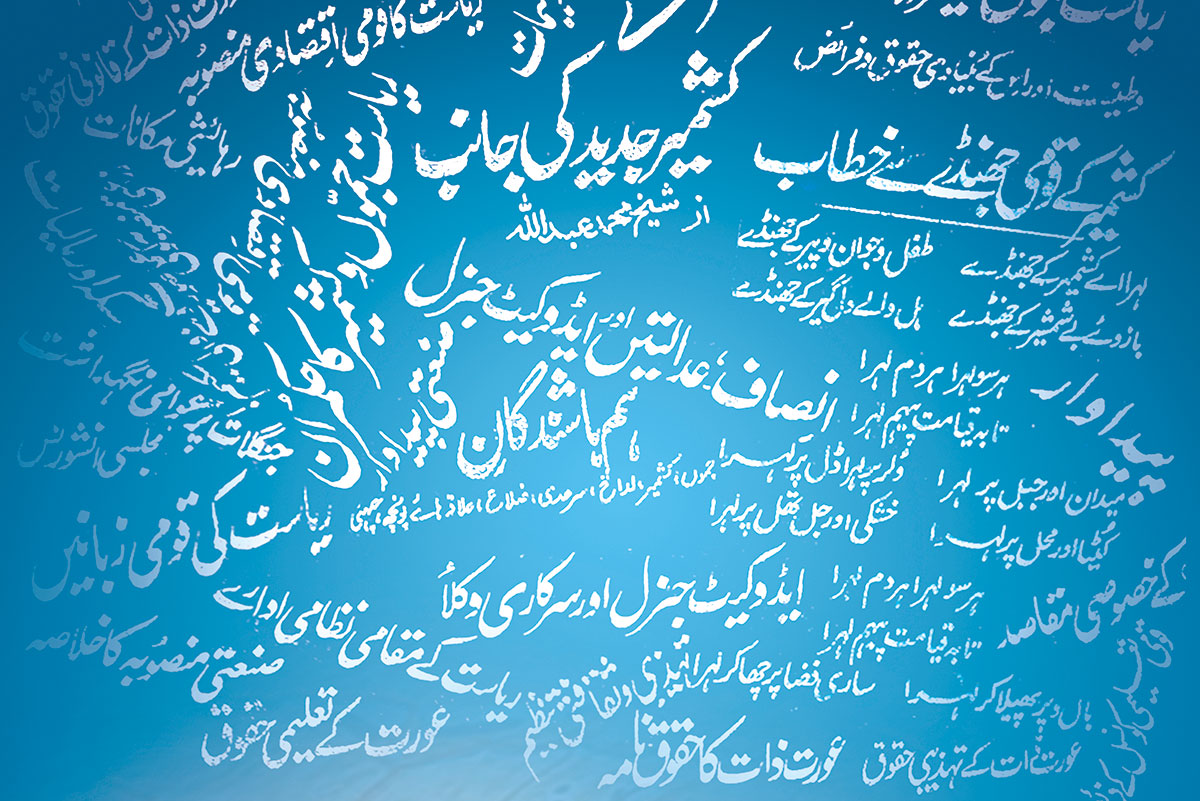
Cover-Illustration---Urdu-LanguageThe law that will govern the Union Territory (UT) of Jammu and Kashmir from November 1, empowers the yet to be constituted assembly to decide the language of the new territory. The Jammu and Kashmir Reorganization Act, 2019, reads: “47. (1) The Legislative Assembly may by law adopt any one or more of the languages in use in the Union territory of Jammu and Kashmir or Hindi as the official language or languages to be used for all or any of the official purposes of the Union territory of Jammu and Kashmir.”
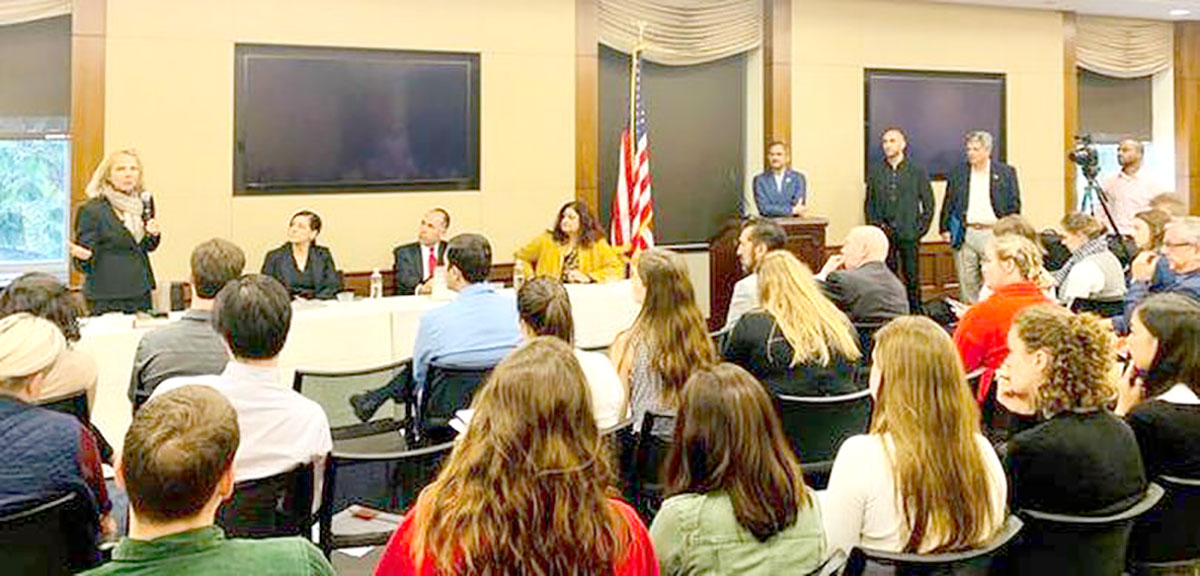
This opens a widow for introduction of a new official language, which could even mean burying the Urdu as the official language of the Jammu and Kashmir state that will cease to exist on October 31, 2019. “The Reorganisation Act is very clear that the new official language or languages will be chosen by the new Assembly,” Farooq Khan, one of the advisers of the governor Satya Pal Malik was quoted saying by The Indian Express. “Hindi is the national language so it would be an official language of the Union Territory of J&K. Urdu will also be given its due place. English will also be used as it is being used currently.”

Home Minister Amit Shah’s insistence that a nation must have one national language has already triggered a sort of a storm in south Indian states that have strong local languages. They see Shah’s idea an imposition of Hindi on non-cow belt. How those states will respond to the idea will take time. But Jammu and Kashmir that has been stripped of its special position and downgraded to a UT may not be in a position to oppose the language-shift given the crisis it is passing through.

The Urdu has already been facing a peculiar situation after the rise of English and the mass computer-dependence. “In the Chief Minister’s secretariat, we once used to have a number of top notch calligraphists who would write official letters of the Chief Minister to dignitaries in Urdu,” one former officer, who served the Chief Ministers secretariat for a long time, said. “As the letters were being sent in Urdu, the people whom they would be addressed would also keep the people in the staff who could read and write. But the section was closed and all letters are now being written in English.”

The name plates of the officials, offices, streets and other public utilities were routinely being done in Urdu and English (in Kashmir) and in Hindi (in Jammu). Though some of them are still being done, the glaring mistakes make the official language a laughing stock.

In the 2011 census, Urdu was mother tongue of  50772631 people in India. In Jammu and Kashmir, however, only 13,351 people (in 12.5 million) mentioned Urdu as their mother tongue. Seemingly, they are the children of the parents, one of whom belongs to the Indian or Pakistan plains. The small number is also because in Jammu and Kashmir, a number of languages are being spoken and people have a huge diversity in the mother-tongues. The people in the state speak eight languages. In Jammu and Kashmir, 6797587 people have Kashmiri as their mother tongue and 2596767 speak Dogri. These are the two of 22 languages falling in eighth schedule of the Constitution of India.

But that does not neutralise the significance of Urdu in Jammu and Kashmir. This is the only language that is sole communication of the entire diversity that lives in Jammu and Kashmir and Ladakh. It is being spoken and understood by different linguistic groups of Jammu and Kashmir. Scripts apart, Urdu and Hindi have a huge common vocabulary. Even the Bollywood sustain Urdu as its lingua franca but barely mentions the film is in Hindi! Bollywood’s most popular numbers are Urdu poetry.

Evolution of Urdu is interesting. It is one of the youngest languages in the world that spread far and wide in less than half a millennium. It owes its genesis to the Mughal era when the Persian was the most predominant court language. It took its own time in moving from Khadi Boli to Hindavi to Dahlavi to Raikhta to Hindustani and finally to the Urdu. Its beauty lies in its capacity to absorb other languages. Lot of its vocabulary is rooted in Arabic, Hindi, Persian, Turkish, English, Latin, and even Sanskrit. Awadh and Deccan apart, for most of its history, Urdu evolved mostly in undivided north India. When the East India Company finally took over India from the dying Mughals, they used Urdu as their communicating language.

In case of Jammu and Kashmir, Urdu has slightly different story. For most of the post-Buddhist period, Sanskrit was the main language of literature, history and the court. It witnessed its decline with the weakening of the Hindu kingdom. When the Shahmirs’ took over and established the Sultanate, the Persian took over. Despite Persian being the court language, the entire Rajatarangni series continued to be written in Sanskrit. During the Mughal occupation of Kashmir, Persian was at its zenith. Afghan tyrants continued with the same language. But the decline started with the Sikh tyranny. Lahore Durbar had Persian as its court language but Urdu was much in use and popular in the mainland India.

In 1846, when East India Company sold Kashmir to Gulab Singh, the master of Jammu, for Rs 75 lakh (Nanakshahi), the Treaty of Amritsar was drafted in Persian. After Gulab Singh tookover, the new master of Kashmir attempted pushing the Dogri but this small language lacked the capacity to replace highly evolved Persian. By then, however, Urdu was evolving fast in the mainland India. During the great mutiny in 1857, when the East India Company required help from a bed-ridden Gulab Singh, the request came in a letter written in Urdu, according to Nishat Ansari, who says Dr Karan Singh still retains the original letter. A few thousand soldiers who helped British cull the freedom seekers in 1857, stayed back in Delhi for many months. They were the first major group from Jammu and Kashmir who returned home with basic Urdu skills.

Language historians insist that Christian missionaries played a vital part in the spread of Urdu. The first batch of evangelical missionaries reached Jammu as early as 1862. They were speaking Urdu and distributing literature in Urdu. By 1888, they set up the first Church in Jammu.

Habib Kaifvi in his Kashmir Mein Urdu has written that the first prose in Urdu in Kashmir was a travelogue penned by Choudhary Sher Singh, a resident of Poonch, in 1865. He was deployed by Gulab Singh to study the trade in Bukhara. On his return, he submitted a 150-page travelogue, which, the writer says is part of the Jammu and Kashmir’s archival records. Even prior to that Bhut Mal, a Jammu resident who was deployed to supervise tea plantation in Jammu, submitted his report to the Durbar in Urdu in 1856.

After the demise of Ranbir Singh in 1885, a situation emerged that East India Company appointed a Resident formally who would manage the state of Jammu and Kashmir through a State Council. This was a decision dictated partly by palace intrigues and partly by the Great Games of which Kashmir has historically remained a principal victim till date. Though the idea was that British would rule the state indirectly to ensure the end of Dogra tyranny, it, however, ended in restoration of the full ruling rights to Ranbir Singh.

With British in Srinagar formally part of the ruling systems, Urdu became a mode of communication. Eventually in 1889, Ranbir Singh declared Urdu as official language of the state. While it helped the British to communicate better, it helped the sovereign to use Urdu as a better communication within the linguistic diversity that existed in Jammu and Kashmir.

“We tried to our best but could not trace the order,” Mohammad Ashraf Tak, the Urdu editor in the Jammu and Kashmir Academy of Culture and Languages, said. “It is a major milestone in the evolution of the Urdu story in Jammu and Kashmir.”

Soon after, Maharaja set up a translation cell at Jammu where key books were rendered into Urdu. Later, he set up a printing press named Bidya Bilas and also permitted the first Urdu newspaper with the same name. Edited by Pandit Gopi Nath Gurtoo, the newspaper was up and running till 1938.

There were efforts from various sides to help Urdu grow. “During the period some Parsi Theatrical Companies of Bombay got an opportunity to stage played called Nataks,” Ansari wrote in an essay on Urdu. “Besides, the professional Urdu signers from Punjab rushed to Kashmir and under their influence all the streets, bazars and lanes of Jammu and Srinagar echoed with their melodious songs in Urdu. All these agencies combined to make the J&K State a platform for popularising Urdu.”

Urdu led to certain changes quickly. “With the formation of the council in 1899, the first order dispensed was the alteration of the official language from Persian to Urdu,” scholar DrNitinChandel wrote in Kashmiri PanditsIn The Political History of Jammu and Kashmir (1846-1947). “With this change the Pandits who with their masterly of Persian dominating the administrative services, were thrown out of their jobs and these jobs were soon captured by the Punjabis people coming from the neighbouring province of the Punjab, waves of office hunters from outsides moved towards Kashmir. They got employment in every office. All the important positions came to be occupied by the Punjabi Hindus, and even in subordinate offices they found place in large number.”

This change was fundamental to a mass movement that Kashmiri Pandits and the Jammu Dogras launched for the state subject rights. These rights were eventually given by the Maharaja Ranbir Singh in 1927 by defining the state subjects of Jammu and Kashmir. By then, however, Kashmiri Pandits had successfully managed reclaiming part of the administration by picking up Urdu in private academies that the migrant Pandits had set up in Allahabad and other places. After centuries of investment to pick up the best of Persian and excelling in it,Pandits embraced Urdu finally.

Mumtaz Sadiq Khan, a scholar of the University of Sindh in his Kashmir Mein Urdu Nasr Ka Tehqiqui Mutala 1877-1996 asserts that Kashmir’s two Urdu poets Shiv NaraianBhanAajiz and Dinna Nath Chiken Mast emerged well before the Urdu was declared the official language of the state. But the language was adopted by Jammu quicker and earlier than Kashmir. Jammu had a flourishing Urdu Bazaar that became Rajinder Bazaar post-partition when mass rioting changed the demographic composition of the city. Mumtaz has established the first Mushaira, poetic gathering, in Jammu and Kashmir took place in 1924 at Jammu that Kaifi Dehalvi presided and Rachpal Singh Shaida conducted.

“During the linguistic re-organisation of the Indian states in 1956, Urdu continued to be the state official language of Kashmir, ironically, the only state in India where a non-native language is the official language,” scholar Mohammad Ashraf Bhat wrote in his paper Emergence of the Urdu in Jammu and Kashmir. Unlike rest of India where Urdu is the language of Madrassa, Bhat asserts that in Kashmir “Urdu is being associated with social prestige, and is perceived as means of upward economic and social mobility.” The cumulative print order of Urdu newspaper in Kashmir is much bigger than English, even today.

In the last 130 years, Urdu has evolved into a huge movement in Jammu and Kashmir. “In J&K, Urdu is the language of land and revenue records, courts (especially lower judiciary) and police (FIRs etc are all written in Urdu),” journalist Muzamil Jaleel wrote in The Indian Express. “With different languages spoken in J&K — Kashmiri, Dogri, Gojri, Ladakhi, Pahari and Balti – Urdu emerged as a link language during Dogra rule, especially because it wasn’t the mother tongue of any substantial group.” Even the Pashto-speaking linguistic minority is using Urdu as the only language of interaction with all others around.

Most of Islamic religious literature that was written in last 150 years is in Urdu. That is perhaps why Urdu is the only selling language in Jammu and Kashmir and will continue to remain so.

The decline, according to Jaleel, started with the introduction of All India Services (IAS) in J&K in 1962. This was because majority of IAS, IPS officers being non-locals preferred English over Urdu. But the decline in the higher echelons of power did not impact the growth of Urdu in the state or the governance systems.

But the patronage reduced to a large extent because post-partition, section of political class linked Urdu to Muslims. They sought the vindication of their bias in Pakistan adopting Urdu as the country’s official language. This is despite the fact that Urdu progressed more in India than in Pakistan. Most of Indian Prime Ministers were voracious Urdu readers. Former J&K Governor N NVohra would start his day by studying the local Urdu newspapers.

Urdu remained neutral to populations across the faiths and the linguistic groups in Jammu and Kashmir. But part of the neglect was rooted in other actions of the society. In the last four decades, the identity assertion in Jammu and Kashmir linked the campaign to the language. A movement in Srinagar launched by language -enthusiasts forced the government twice to make Kashmiri compulsory in the schools up to the middle level. This created similar campaigns in Ladakh and Jammu for Ladakhi and Dogri. This movement ate the larger lingual pie from the Urdu. Right now, in most of the urban Srinagar, students, mostly from private schools, are unable to manage Urdu (the problem is writing and not speaking) unless they fell in love and require the hypnotic Urdu poetry. Many love Urdu for the revolutionary appeal that the language offers.

This situation has led to a language load on the students. They require English as the sole language of knowledge. They have to study Kashmiri because it is compulsory and mother tongue. They have to pick up the basics of Arabic because this is the language of the God’s word. They cannot avoid Urdu because this is the language that retains their history, culture, faith and all basics that make them what they are. Urdu, Kashmiri, Dogri are recognized languages in the eighth schedule of the constitution of India.

Right now, the fate of Urdu hangs in balance in Jammu and Kashmir. As the Ministry of Home Affairs – now the new master of the UT of Jammu and Kashmir is planning the UT roll-out, nobody knows the fate of the language. The law says that the new assembly will decide. But who knows when the new assembly will be constituted and in what form.

Regardless of the decision-making, one thing is sure: Urdu is unlikely to follow Sanskrit or Persian and get into oblivion.


from Kashmir Life https://ift.tt/36bq42F
via IFTTThttps://kashmirlife.net

A Red Hearing?

There were some highly uncomfortable questions that American Congressmen asked its own officials on Kashmir. The hearing by a Congress Committee on Foreign Affairs, however, led to some clarity in the US stand. The Trump administration sees Delhi’s Kashmir interventions as internal but having external consequences. The sole American concern remains if at all Kashmir can live in dignity, reports Tasavur Mushtaq

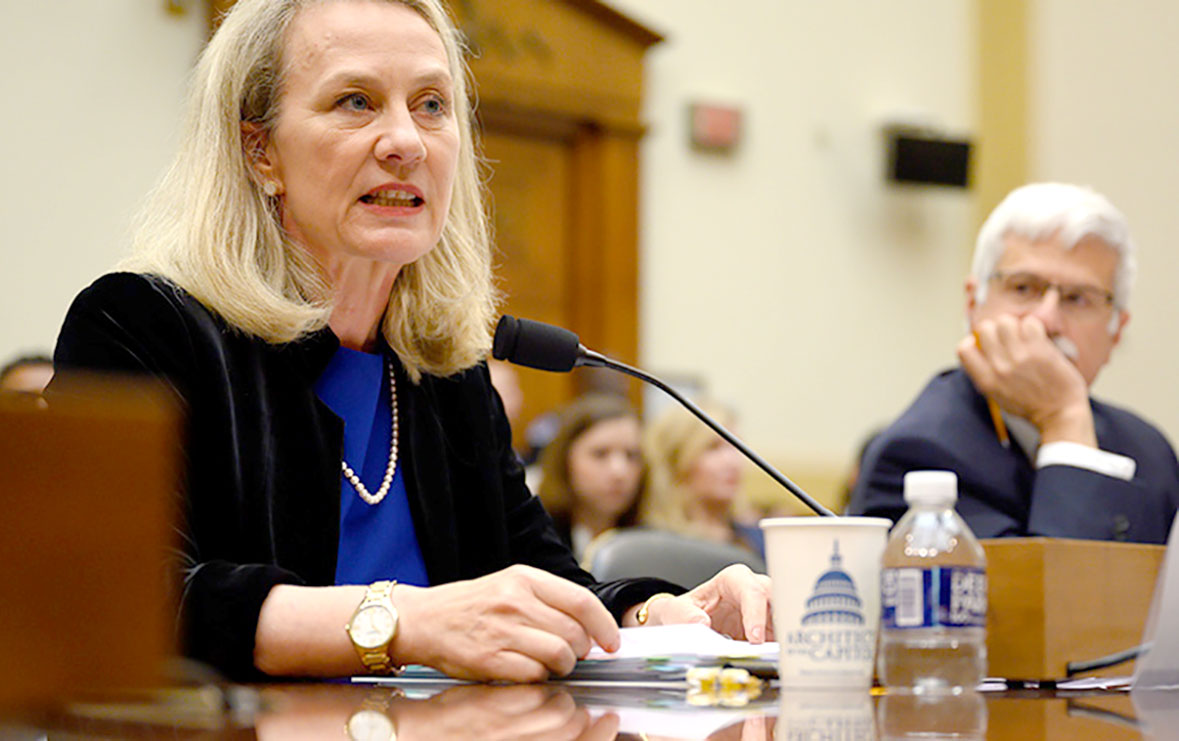
Alice G Wells, acting assistant secretary testifying before HFAC as her colleague Robert Destro is watching.

Alice G Wells, acting assistant secretary testifying before HFAC as her colleague Robert Destro is watching.

Weeks after Senator Chris Van Hollen mooted an amendment in a crucial report ahead of the annual Foreign Appropriations Act for 2020, that allocates federal funds for furthering American foreign policy, a hearing on Kashmir by the US House of Representatives’ Foreign Affairs Committee (HFAC) offered a rare insight of the US Kashmir policy and concerns of individual Congressmen.

The Asia Sub-Committee actually grilled the State Department officials and heard many people from diverse backgrounds on contemporary Kashmir. Their interventions indicated that the Kashmiri Americans have been quite active educating them about the happenings in Kashmir. The final takeaway was that Trump administration is not opposed to the abrogation of the special status and the downgrade of the state of Jammu and Kashmir to a remotely ruled Union Territory. However, it wanted the bilateral talks between India and Pakistan to resume and is keen to take a position on “whether Kashmiris can live in dignity, and have a full economic and political life.”

Against an expectation that the Committee would take care of the entire South Asia, the Sub Committee Chairman Brad Sherman ruled at the outset that the focus would be Kashmir. He actually said the entire world is “focused today on what is happening in Kashmir.”

“Since the August 5 revocation of Articles 370 and 35A of the Indian Constitution, we have urged the Indian government to balance its security priorities with respect for human rights,” Assistant Secretary of State for Democracy, Human Rights and Labour Robert Destro told the Sub-Committee according to Press Trust of India (PTI). “In August, Prime Minister (Narendra) Modi announced a plan to return the region to normal order, which is something we would welcome. Thus far, however, the picture remains mixed.” While landlines and post-paid mobiles were restored, pre-paid mobile services and internet are still switched off. “With communications blocked, local activists and journalists are not able to provide updates on the current environment in the Valley,” he said.

Ms Alice G Wells, the acting Assistant Secretary South Asia, told the Committee that Washington has been seeking full restoration of communications but pre-paid mobile services and internet services remained switched off. She said Delhi denied Washington permission to visit Kashmir saying “this is not the right time” to visit.

Wells, according to Hindustan Times supported scrapping Kashmir’s special status but asserted the State Department “remains concerned about the situation in the Kashmir Valley, where daily life for the nearly eight million residents has been severely impacted since August 5.”

A Kashmir related discussion in which various Congress men participated.

A Kashmir related discussion in which various Congress men participated.

“While conditions in Jammu and Ladakh have improved, the Valley has not returned to normal,” she was quoted saying. “The department has raised concerns with the Indian government regarding the detentions of local residents and political leaders, including three former Chief Ministers of Jammu and Kashmir.”

Wells said the US believes a direct bilateral dialogue under the Simla Agreement “holds the most potential for reducing tensions”. “We believe the foundation of any successful dialogue between India and Pakistan is based on Pakistan taking sustained and irreversible steps against militants and terrorists in its territory,” she was quoted saying. “Restarting a productive bilateral dialogue requires building trust, and the chief obstacle remains Pakistan’s continued support for extremist groups that engage in cross-border terrorism.”

Those who testified before the subcommittee submitted written statements and responded to the questions from the members as well.

Wells described the release of small numbers of political leaders and the Supreme Court planning to hear petitions related to Kashmir on November 14 as “incremental” steps, insisting the security situation remained tense. She specifically called on Delhi, according to Voice of America to hold “local assembly elections at the earliest opportunity” and release political leaders.

The two officials faced pointed questions.

Sherman asked if Kashmir’s cut-off from the rest of the world was actually to prevent cross-border terrorist attacks and if there are any “verified cross-border terrorism” incidents since Aug 5? Wells said there were “hearing different stories from different sides” but “we have observed a decline in the incidents of infiltration.”

“Is this a humanitarian crisis?” The Hindu quoted Texas Congresswoman, Sheila Jackson Lee asking Robert Destro, who testified before the Committee. “Yes, it is.” Destro responded. “From a 72,000 foot perspective, it’s a crisis. To the individual families who are involved, it’s a disaster.”

Asked whether the current tensions between India and Pakistan could trigger a conflict, Wells said the US recognises Kashmir as India’s “internal problem” but it was a “problem that has external consequences”. She said Trump has engaged both the Prime Ministers on multiple occasions.

“I believe there have been human rights violations. Yes,” Ms Wells responded when asked by Congressman Jim Costa, a California Democrat.

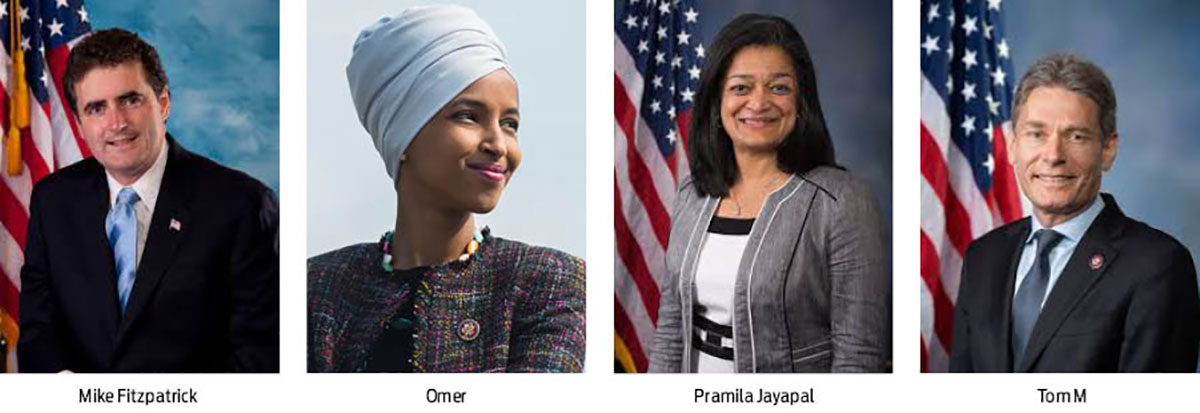
At least, three lawmakers, Ilhan Omar, Tom Malinowski and David Cicilline asked testifying US officials whether Delhi’s motivation behind abrogation of Article 370 was a national security or an ultra-nationalist and majoritarian agenda.

“To what extent is this a result of the BJP and RSS, particularly RSS, … ultra-nationalist sentiment, driving this effort and this assault in Kashmir?” Cicilline, a Rhode Island Democrat, was quoted by the Pakistani newspaper Dawn asking. “What are we doing to combat that and help them recognise that this is not an appropriate way to behave in a democracy?”

Wells answered: “The revocation of Article 370 has long been a mainstay of the BJP political platform. So, when PM Modi won majority in this latest election, in which 67 per cent of Indians participated, the government quickly and without consultations with us, (moved) to implement it..The revocation is a little bit of a canard …, we are not taking a position on Article 370, we are taking a position on whether Kashmiris can live in dignity and have a full economic and political life.”

Almost half a dozen members of the penal repeatedly raised the denial by Delhi, unlike Islamabad, to the proposed visit of Maryland Senator Chris Van Hollen. “No we don’t think it’s helpful,” Robert Destro, as quoted by Turkish Anadolu Agency responded to a pointed question on the denial of permission. “It’s actually counterproductive.”

David Trone from Maryland asked about the reasoning given by India for not allowing access to US officials and diplomats. “They said that it is not the right time,” The Wire quoted Wells saying. “Seems like the right time exactly,” responded Trone.

The Committee members made observations also. Talking about the ban on foreign journalists’ visits to Kashmir, Sherman, the Committee Chairman asserted: “Every day we need an impartial view of what is happening there.”

Pramila Jayapal, the Chennai-born Congresswoman from Washington, who was an Indian citizen for 35 years, according to The Hindu raised the issue of children being detained. She actually mentioned the case of Dr Mubeen Shah, a businessman, who, she said has been detained without an offence. “This is unacceptable…the detention without charges,” Jayapal said, in reference to the Public Safety Act. Hindustan Times reported she was in India when the status of Kashmir was changed. “I have made clear my concerns about a communications blockade and the detentions,” she said. “I recognize the situation is complex – and Pakistan is not without responsibility, (but) mutual commitment to human rights remain.”

Abigail Spanberger, Virginia Congresswoman, who joined politics after her tenure in CIA, pointed out the differences between the accounts she was getting from her voters having families in Kashmir and official accounts from Delhi. She outlined stories from her constituents and asked how the US was getting sources of objective, verifiable information. “I want to find out the truth,” she said. “There’s limited reporting in the press…” She wanted a classified hearing on the nature of security threats in Kashmir.

Congresswoman Ilhan Omar, who has been highly critical of India on Kashmir, according to PTI said US partnership with India is strategic but is also based on common values of human rights and democracy. “The government of Prime Minister NarendraModi and the BJP has threatened all these values, she alleged.” Wells, however, disagreed with the Somalia origin lawmaker saying Modi government adopted the “democratic process” in “abrogating Article 370 of the Indian Constitution”.

New Jersey’s Tom Malinowski asked US officials whether they considered restrictions on access to journalists and diplomats to a region useful from a counter-terrorism point of view. “It is counter-productive, in our view,” replied Destro. He commented that the communication blockade and restrictions actually “dis-empowers the very people who want to be our allies”.

Lawmakers Ted Yoho and Mike Fitzpatrick also expressed concern over the human rights situation in Kashmir and urged India to take steps to lift restrictions on movement of people, communication restrictions and detention of political leaders. The US goal, Fitzpatrick said should be to uncover the truth. She also called for a classified hearing on threats from terrorists from Pakistan in Kashmir.

In anticipation of the hearing, Delhi worked overtimes to reach out to American lawmakers. India’s Ambassador in the US, Harshvardhan Shringla met Sherman on October 10, in which he responded to Sherman’s “serious questions” on Kashmir.

Later, PTI reported that Kashmiri Pandits residing across the US held a briefing for US lawmakers and their aides. Participants included Indian American Congressman Ro Khanna, Congressmen Mike Thompson, Zoe Lofgren, Mark Desaulneir and Doris Matsui along with Chairman of House of Foreign Relation Committee, Elliot Engel. Kashmir Overseas Association president Shakun Malik talked about the plight of Kashmiri Pandits and the discrimination faced by Kashmiri women, minorities and weaker sections of the society due to Articles 370 and 35A. Some of the host members shared their stories of the migration.

Kashmiri Americans were also on road for many days before and after Prime Minister Modi’s US visit. Some of them, like Kashmiri Pandits, have their own influences at the local lawmaker level. The penal had invited at least five persons in their private capacities to testify. These included Nitasha Kaul, Associate Professor in Politics and International Relations at the University of Westminster; Angana Chatterji, an anthropologist from the University of California; Ravi Batra from the National Advisory Council of South Asian Affairs; Aarti Tickoo Singh, an Assistant Editor of The Times of India; and Francisco Bencosme from the Amnesty International. “While three speakers criticised the government on the human rights situation in Kashmir, two others defended New Delhi’s moves,” The Indian Express reported.

Hours ahead of the hearing, India’s foreign minister Dr S Jaishankar blamed America’s “English-speaking so-called liberal media” for making it difficult for Delhi to explain the decision of abrogating Kashmir’s special status. “I think it was a more difficult challenge with the media, especially the English-speaking liberal media (in the West). Partly, because they were ideological about (Jammu and Kashmir), and they had strong preset views about it,” Jaishankar said at an interaction at the US-India Leadership Summit organised by US-India Strategic Partnership Forum (USISPF). “My view was that they didn’t present a fair picture or absorb it.”

Insisting that abrogation was India’s “internal business”, mooted “for the benefit of the people of Kashmir”, Jaishankar explained: “There were development obstacles in Kashmir. The cost of business was much higher. Article 370 narrowed the scope for business and raised the cost of business, which meant there was less development.” He blamed Western media for not “absorbing facts” and reporting the temporary nature of Article 370.

“This change is our internal business but obviously there was interest around the world because different people had views about it and our neighbours made a bit of a fuss about it,” he was quoted saying.

A Red Hearing (Special Report)

Delhi did not miss the message. “It is regrettable that a few members of the US Congress used the Congressional hearing on human rights in South Asia to question the measures taken recently to safeguard life, peace and security in Kashmir,” Raveesh Kumar told reporters in Delhi. “These comments display a very limited understanding of India’s history, her pluralistic society, constitutionally guaranteed freedom, fundamental rights and the robust institutions operating in the world’s largest democracy.”

Timothy Roemer, a former US envoy to India, who also attended the Delhi function told The Hindu that India must address the US Congress and the government with some “depth and clarity” on the issue of Jammu and Kashmir.

“I would recommend that the US should hear more about what exactly is going on up (in Kashmir) and see some depth and clarity to it,” he said. “Is the Internet off or on? Who is being detained and for what reason? Also how is India managing its controlled area compared to how Pakistan is managing its controlled area….these are important issues which the Congress should engage with.”

Many days later, the US reiterated its concern even though part of the communication clampdown was undone. “We’ve seen progress, for example, four million post-paid mobile phone users have had service restored, but SMS and internet is restricted,” Wells told reporters at Foggy Bottom headquarters of the State Department, insisting the US continues to be concerned. “We continue to press for the release of detainees for the full restoration of everyday services, but most importantly, for roadmap to the restoration of political and economic normalcy.”

The administration continues to insist that the Oval Office wishes to play a role, if given. “He [Trump] certainly is prepared to play a mediation role, if both the countries ask,” an unnamed official was quoted saying by the PTI. “It has been India’s position not to seek outside mediation.”


from Kashmir Life https://ift.tt/2WloZ3J
via IFTTThttps://kashmirlife.net

Dead body of suspected militant recovered in Bijbehara: Police

SRINAGAR: Police on Tuesday said that in a terror crime incident, a truck driver was killed yesterday in firing by militants at Kanilwal area of Bijbehara, Anantnag in south Kashmir.

The police spokesman in a statement said that immediately after the incident, police and security forces launched an operation in the area and subsequently during the search, recovered a dead body. Based on the preliminary investigation it is learnt that the said individual was part of a group involved in terror crime incident at Kanilwan Bijbehara.

Identity and affiliation of suspected militant is being ascertained. Police have registered a case in this regard. Officers are investigating the circumstances of this terror crime.


from Kashmir Life https://ift.tt/31Wv7jO
via IFTTThttps://kashmirlife.net

Srinagar Police arrests 4 drug peddlers, psychotropic substance seized

SRINAGAR: Police has continued its action against drug dealings in Srinagar. Four drug peddlers were arrested at a checkpoint and psychotropic substance was recovered from their possession.

A police spokesman said that officers at a checkpoint established at Rajouri Kadal intercepted and arrested four drug peddlers identified as Shahid-ul-Islam resident of Nowpora Khanyar, Suhail Maqsood Bhat resident of Rajouri Kadal Nowhatta, Muneer Ahmad Parry and Rafeeq Ahmad Parry both residents of Pandach Parry Mohalla.

Officers at the checkpoint recovered 83 Tablets of Spasmoproxyvon Plus from their possession. They have been shifted to Police Station Nowhatta where they remain in custody.

Case FIR No. 54/2019 under relevant sections of law has been registered and investigation initiated.

Community members are requested to come forward with any information regarding drug peddlers in their neighborhood. Persons found indulging in drug peddling will be dealt as per law, the spokesman said.


from Kashmir Life https://ift.tt/2PDqMzV
via IFTTThttps://kashmirlife.net