SRINAGAR: Former Minister and senior leader Jammu and Kashmir National Conference Ajay Sadhotra has expressed serious concern over the move to convert the Historic Mubarak Mandi complex into a hotel.
Opposing the move, Sadhotra alleged that BJP Government is hell-bent upon vanishing Dogra history and culture.
“First BJP divided princely State into two union territories, secondly abolish 35-A which was protection for land and jobs security to the people of Jammu and Kashmir and now converting the Historic Mubarak Mandi complex into a hotel”, he added.
He said that the people of Jammu and Kashmir have an emotional attachment with the historic monument as it was the seat of power of the Dogra dynasty and any attempt to convert this Heritage building to a hotel will create bad blood.
If the building is preserved as Monument, thousands of tourists from the country and outside the country will come to see and know about the Dogra history and history of princely J&K State, he added.
He asked the Government to review its decision of converting this Monument into the hotel and preserve it as a Heritage Monument as has been done by the Hyderabad Government by preserving the Chowmahalla Palace of Nizam of Hyderabad.
“Government should take up the execution of a master plan of this historical Mubarak Mandi on war footing as crores of rupees has been spent on Mubarak Mandi time to time by different Governments”, he stated.
from Kashmir Life https://ift.tt/3yhTWb5
via IFTTThttps://kashmirlife.net
SRINAGAR: A 63-year-old man was crushed to death by a train in Badragund area of Qazigund in south Kashmir’s Anantnag district on Friday morning.
Quoting an official the news agency KNO reported that a retired government employee of Irrigation and Flood Control (I&FC) Department namely Ghulam Nabi Chopan, son of Abdul Aziz Chopan of Vessu Qazigund was crushed by a train at around 11:00 am, resulting in his on spot death.
“It was not known whether he has committed suicide,” the official said, adding that police has started an investigation in this regard.
Station House Officer (SHO) Qazigund, Reshi Irshad also confirmed the incident.
from Kashmir Life https://ift.tt/3fb3YTX
via IFTTThttps://kashmirlife.net
SRINAGAR: A man was arrested in Uri town of Baramulla for allegedly raping a minor girl inside a forest area, police said.
In a statement, police said: “On 28,07,2021, Police Station Uri received a written complaint from one person stating therein that his minor daughter (name withheld) aged about 13 years was raped by one person namely Imtiyaz Ahmad Khan @ Muna Khan, son of Mohammad Saleem, a resident of Paranpeelan Uri in forest area after giving life threat to her.
On receiving this complaint, a case under relevant sections of law was registered in Police Station Uri and investigation was set into motion, the statement said.
During the course of the investigation, The Police team after utilizing all available means and due to strenuous efforts arrested the accused person within hours of the complaint received by police. He has been shifted to the police station where he remains in custody.
As a part of the investigation, necessary medico-legal formalities have been carried out. Further investigation in the matter is going on, it said.
from Kashmir Life https://ift.tt/3BUfv3N
via IFTTThttps://kashmirlife.net
New Delhi: India recorded 44,230 fresh Covid-19 cases with 555 deaths in the last 24 hours, the Ministry of Health and Family Welfare data showed on Friday.
On Tuesday, India had registered 29,689 new Covid cases, less than the 30,000-mark in 132 days, and 415 deaths.
The total number of deaths has reached 4,23,217 as per the government data and active cases number 4,05,155.
According to the government, 42,360 people were discharged from hospitals and health centres in the last 24 hours, taking the total number of cured to 3,07,43,972 till date as the virus continued to infect less than one lakh people over the last 52 days.
A total of 45,60,33,754 Covid vaccine doses have been administered in India so far, including 51,83,180 in the last 24 hours.
The total number of samples tested so far has reached 46,46,50,723 as on July 29, including 18,16,277 samples tested on Thursday.
from Kashmir Life https://ift.tt/2V7BrYt
via IFTTThttps://kashmirlife.net
SRINAGAR: Body of a 45-year-old woman was found in an orchard in Gutiyar area of North Kashmir’s Baramulla district on Friday morning.
Quoting official sources the news agency KNO reported that the body of Fareeda Begum wife of Gulzar Ahmad Mir of Gutiyar was found in the orchard.
They said that she had gone missing yesterday when she had gone to her orchard in Gutiyar, following which searches were launched to trace her.
“Today morning body was found in the orchard and it has been now taken to the hospital for post-mortem to ascertain the cause of here death,” they said.
Meanwhile, Baramulla police have taken cognizance of the incident and have a registered a case, while further investigations have also been taken up.
from Kashmir Life https://ift.tt/3ieK38G
via IFTTThttps://kashmirlife.net
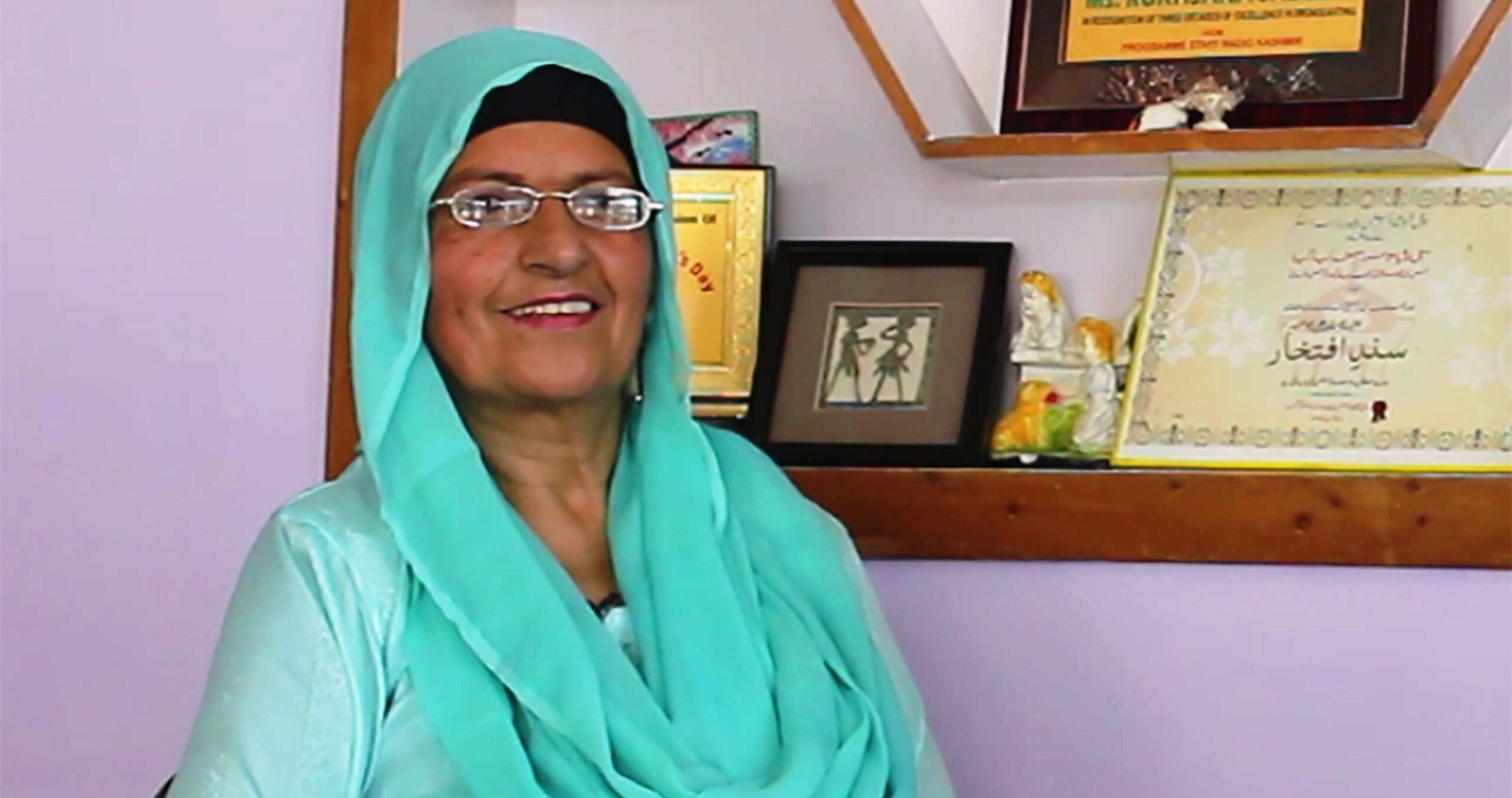
Broadcaster and poet,Rukhsana Jabeenretired as Director of Radio Kashmir. She tellsIbtisam Fayaz Khanthat withdrawing Urdu from its standing as the sole official language of Jammu and Kashmir was a huge loss.
Rukhsana Jabeen
KASHMIR LIFE (KL):Your literary and broadcasting journey was interesting because it was a different era?
RUKHSANA JABEEN (RJ): It all began in 1977. I took admission for masters in Urdu at the University of Kashmir. Like the Persian department, the Urdu department had a literary circuit called Bazm-e-Adab. Students would participate in its events and present their prose and poetry. Teachers used to evaluate and improve our writings. Professor Hamidi Kashmiri was one of the teachers who used to mentor students including me by providing us with books and encouraged us to write. My work used to get published in our departmental newsletter Bazyaft. That is how it began.
My writings were appreciated from within and outside Kashmir. Shabkhoon used to be one of the prominent magazines and publishing in the magazine would fetch instant recognition and respect. After my masters, I did my pre-doctorate (MPhil) on contemporary Persian Poetry in Iran. Forugh Farrokhzad is my favourite Iranian poet.
KL:How was your schooling, your childhood, your aim in life?
RJ: I am originally from Khwaja Bazar Srinagar. I have studied in a government school where the taath (sitting mats) used to be prickly. That was a different era, simple and modest. Then I moved to Khanyar High school which was later upgraded to a higher secondary. I remember Nallahmar Road used to be a big orchard once, which is now a concrete jungle. After that, I went to Nawakadal College for women. I have lived in a downtown environment and I personify that culture. Finally, I moved to the University where I studied both Urdu and Persian.
As you asked about my childhood habits and my dreams, I had a flashback that as a small girl I used to take glass and spoon. Spoon was my mike and I used to mimic the radio broadcasters and their shows focusing majorly on women at that time. It used to be in the Kashmiri language programmes hosted by Mariyam Begum and Uma Dhar. I used to be in plays, unlike other children. One day these childhood plays became real in my life.
We were two sisters and our parents never discriminated against us as they had no son. They never treated us any less. We were encouraged to study and supported to fulfil our dreams. My mother did not let me do any household work as she wanted us to focus on our studies. And today I treat my daughter the same way.
KL:How did your family provide support when you started writing poetry?
RJ: They never objected to my poetic skills but they objected to working for the radio. Going to radio was considered taboo in that era. They were very sceptical about “our girl will go to the radio station”. Our home environment was traditional, a peer Gharana. People believed that only singers and theatre personalities go to radio. They were unaware that formal official positions do exist, even for women. Family and relatives did not like to hear my voice on the radio. I used to give excuses that radio personnel come to our university and record our voices as our writings were published in Bazm-e-Adab. Later, they appreciated and relatives started seeking radio jobs for their daughters too.
KL:And then you put in 32 years in broadcasting?
RJ: In 1982, Basharat Ahmad, my ideal broadcaster, suggested that I should apply for the programme officer post in Radio Kashmir for which I had to sit in the PECS examination conducted by UPSC. I got selected as an Urdu programme officer. I joined radio in 1983. Initially, I worked with Yuvavni, and eventually, I was deployed to the general service section of the radio. The way seniors supported and encouraged me throughout, I did the same for the deserving and talented juniors.
For the initial five years at Yuvavani, I moved with my team from village to village in OB vans. I was the first Muslim Kashmiri girl to work as a programme officer. I broke the myth that Muslim girls have their limitations in being professional broadcasters. I always wanted my assignments to be distinct from others. I made sure to work hard and prove my mettle. Except for music and drama, I managed all kinds of programmes. My Payame Subuh was the morning radio programme that was very popular.
KL:Do you believe that the reputation and success of public broadcasting has compromised in the All India Radio era?
RJ: Yes, it has. Now, young people are not involved in office work. The young blood is required so that Radio Kashmir revives itself. With time, people change and so do their preferences. If youth are not the workforce, there won’t be anything new in the content. The staff is old and belong to a different generation. They are not even hiring new people. This has caused a lot of problems. Radio was the most popular public forum in Kashmir and it had more listenership than other states. Youth can’t apply unless and until posts are not advertised. Accountability does not exist now.
KL:Has the privatization of radio stations affected the listenership of All India Radio?
RJ: Private station cannot compete with All India Radio. Kehtay haina haathi mara huwa bhi sawa lakha ka hota hai…. Zawal aatay aatay bhi bharsoon lagengay…. At the same time, I appreciate the energetic talent manning private stations. There is no competition to All India Radio as for as its reputation, the sensitivity of content, and message delivery is concerned.
KL:What has been the main theme of your writings?
RJ: Life is the main theme of my writings as it is colourful, sometimes black and white, and sometimes grey. These colours of life become the subject of our writings. I prefer to write ghazals because it has the aura of freedom to write what we feel. It is not bounded or restricted.
KL:How do you see the current status of the Urdu language in Kashmir?
RJ: It is beyond hope but I still expect rays of sunshine as I always prefer to looking at every situation as an optimist.
KL:Urdu is no more the only official language?
RJ: Even when Urdu enjoyed being the only official language, no policies were made for its promotion and preservation. It is not at all understandable to me how the government can accommodate more than one language in their official works. It is not possible to give all other languages the same position as Urdu has always enjoyed. No one will benefit from this. Instead, it is a huge loss to our culture. Yes, other languages also have their significance and must be preserved. It must be added into curriculums according to the geographical majority.
KL:What should be the steps taken by the government for preserving the Urdu language in the region?
RJ: Urdu academies must be organized as is the case in Delhi, Bengal, Hyderabad, Karnataka, and Haryana. The Jammu and Kashmir Academy of Art, Culture, and Languages works for all the state languages rather than focusing on one language. So we need an academy that will concentrate on the development, promotion, and preservation of Urdu as a language. Government should take these steps for preserving the Urdu language in the region.
Anyway, the situation of Kashmir for the last two years has made us all wonder how to simply survive in these times. Art, culture, and language, all these things are not a priority, unlike life and health. I pray for the situation to become better, politically, socially, and with respect to the pandemic. Then we can take the necessary steps about our Urdu language.
KL:People use Urdu for certificates. Do you believe that it is going away day by day from our lives?
RJ: There was a time when Urdu used to be a craze in Kashmir. Several Mushairay (poetic symposiums) used to be held across Jammu and Kashmir. It is correct that Urdu is being treated merely as a subject to pass an examination. Though that’s not how the knowledge must be pursued. Parents are being careless who don’t recognize the importance of Urdu or, perhaps, they have also been treated the same way by their parents.
Even people who survive on Urdu do not encourage their kids to study the Urdu language. They presume their children won’t survive in the outer world on Urdu alone. Unless and until a language does not become means for earning or employment, it will decline. We have to link these two – Urdu and employment. Several Urdu newspaper houses require Urdu knowing journalists, columnists, typists, editors.
Radio Kashmir is one such platform where Urdu professionals are essential for broadcasting news, make programmes or scriptwriting. Kashmir’s social geography won’t allow the 24/7 English news channel. The region has to have Urdu-speaking news channels for better audience reach and message delivery. Marte marte bhi Urdu kayi logoo ki zindagi raheghi ….. English is equally an important language in today’s world. However, we must not forget or ignore Urdu and Kashmir languages cultural worth.
KL: What should be the responsibility of organizations like Adbee Markaz Kamraz?
RJ:Adbee Markaz Kamraz is the oldest and has completed 50 years for the cause of protecting preserving our own Kashmiri culture and language. They have been doing the best they can. However, Kashmir’s cultural organizations can work much better if they are provided with a good amount of financial funds.
Due to current situations, sub-groups under AMK have not received any monetary aid. For that, a federal organization of these NGOs must themselves be financially self-sufficient. The proper administrative head is absent in any of these literary sub-groups. When Adbee Markaz Kamraz was under the administration of Dr Aziz Hajini, several projects and programmes were arranged for the betterment of the Kashmiri language and culture. From arranging publications to poetic symposiums and Kashmiri musical programs, Musaviri (sketching), their work used to be highly appreciable and was touching skies.
from Kashmir Life https://ift.tt/2WvHk21
via IFTTThttps://kashmirlife.net
SRINAGAR: The Jammu and Kashmir government on Thursday announced a sanction of Rs 25 lakh in favour of the Next of Kins of the elected councillors of Municipal bodies, who have been killed in militancy-related incidents in the Union Territory.
An order issued by Principal Secretary to the government, Dheeraj Gupta, a copy of which lies with the news agency KNO reads that sanction is hereby accorded to the payment of Ex-gratia compensation in favour of elected Councilors of Municipal Bodies of Union Territory of Jammu and Kashmir killed in militancy-related incidents.
The order has been issued in reference to the Administrative Council’s decision under number 84/13/2020 dated 15-07-2020.
The order reads that the ex-gratia compensation shall be paid to the next of kin (NOK) of the deceased by the Government through concerned Deputy Commissioners/ District Development Commissioners.
“The Deputy Commissioner concerned shall prepare, process and submit the case regarding payment of Ex-gratia through Housing and Urban Development Department,” it reads.
It further reads that on the receipt of the case, Housing and Urban Development Department shall forward the case to the Finance Department for release/payment of ex-gratia in favour of NOKs of the deceased.
from Kashmir Life https://ift.tt/3iYE0nS
via IFTTThttps://kashmirlife.net