Wednesday, 30 September 2020

Why ‘Forty Rules of Love’ Is A Wonderful Turkish Novel?

by Umair Rashid

We often look for mistakes in people and disown them quickly. This book has a message to treat everybody with love, kindness and humility. Always try to focus on improving oneself rather than judging and looking for other faults

The Forty Rules of Love is a novel written by Turkish author ElifShafak. He is the acclaimed author of nine novels including The Bastard of Istanbul, The Flea Palace and Honour, and is the most widely read female writer in Turkey. This book was published in 2010 by Penguin Books. This book explains how Shams of Tabriz, the notable Persian poet transformed Mawlana Jalaluddin Rumi, a famous Islamic scholar into a Sufi (mystic) through love.

Turkish Novelist Elif Shafak

The story starts with Ella Rubinstein who has a husband, three teenage children, and a pleasant home. She has everything to feel confident and fulfilled. But still, there is an emptiness at the heart of Ella’s life – an emptiness, which is once filled by love. Being a graduate in English Literature, she is assigned a task to write a report on the manuscript Sweet Blasphemy, a historical, mystical novel on the remarkable bond between Rumi and Shams of Tabriz authored by A Z Zahara.

So when Ella reads this manuscript and the forty rules of life and love marvellously discussed, she is shocked out of herself. Turning her back on her family she embarks on a journey to meet the mysterious author of this work and eventually falls in love with him. The other reason being the unfaithfulness by her husband and the affairs he secretly engages in; paying less attention towards her. This manuscript turns out to be a quest infused with Sufi mysticism and verse, taking Ella and us into an exotic world where faith and love are heartbreakingly explored.

A letter from Master Seyyid Burhaneddin is sent from Kayseri to Baghdad in February 1243 on the name of Baba Zaman, who is the head of the dervishes residing in his supervision. The writer says; “that in Konya there lives a great Islamic scholar by the name Rumi who is so talented and judicious but there is something missing in his life – an emptiness that neither his family nor his disciples can fill. Thus, he is in dire need of a companion, a friend of the paths Quran says “Believers are each other’s mirrors.”

As soon as the letter arrives in the dervish lodge, everyone gets curious about the content of the letter headed to their master. Baba Zaman after reading the letter conveys the same message to all the dervishes and asks them to raise their hands voluntarily for this journey to Konya. Several dervishes raise their hands, excited and impatient before Baba Zaman waves and intervene again by saying these words: “The journey is beset with great danger and unprecedented hardships, and there was no guarantee of coming back.” Instantly all the hands come down except the one of Shams of Tabriz.

Forty Rules of Love, a novel by Elif Shafak

Though initially Baba Zaman doesn’t get happy and convinced with his decision of going there and delays it for some time. However, after some months he sets warmly Shams of Tabriz for this journey to Konya to meet his companion.

Upon this journey, Shams meets with a lot of people and preaches the message of loving God and also how much God loved us. He preaches to feel God’s love towards us. At one time he meets a drunkard who is so ruthlessly beaten by the security guard at midnight for drinking wine and left in blood in the street. On seeing him, Shams greets him warmly and after seeing him in blood gives him silver flask from the pocket of his robe. He asks him to apply this ointment to his wounds. The drunkard gets so surprised by his kindness as he had never seen anyone treat him like this. Rather every one pinched him with taunts and said bad about him even this security guard who treated him so harshly.

When he said this to Shams of Tabriz; he replied “They had no right to do this. Every individual is self-sufficient in his search for the divine. There is a rule regarding this (among their forty rules): We were all treated in His image, and yet we were each treated different and unique. No two people are alike. No two hearts beat to the same rhythm. If God had wanted everyone to be the same, He would have made it so. Therefore, disrespecting differences and imposing your thoughts on others is tantamount to disrespecting God’s holy scheme.”
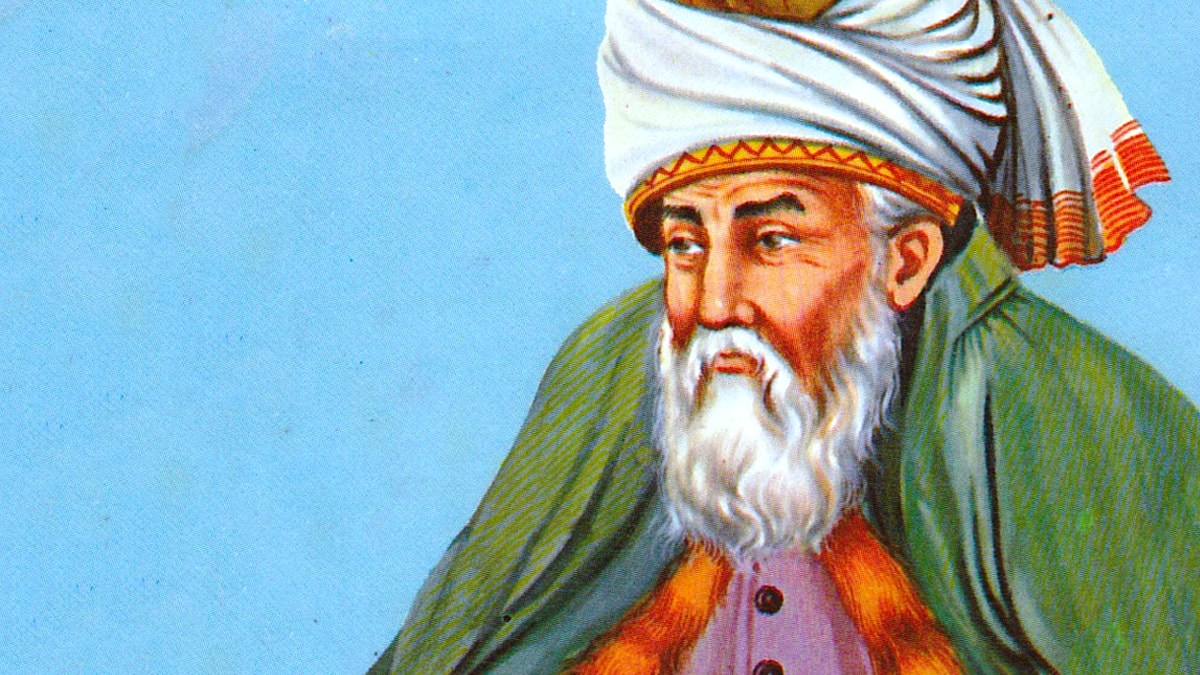
Molvi Moulana Rumi, an art work

Similarly, on another occasion, he saves a whore (who unfortunately in teenage gets landed in a brothel) from getting lynched by people (that too on the instruction of someone who also used to visit brothel) she secretly comes to listen to Rumi’s speech in a mosque. After managing running from there with the help of Shams, she meets him again and whole-heartedly thanks him!

But she also gets so surprised the way Shams treats her despite knowing she is a whore.To this she says, “despite if I want to change and get closer to God, these men will continue to hate me; they will never listen to me.” On this Shams replies, “It’s one of the forty rules. If you want to change the way others treat you, you should first change the way you treat yourself. Unless you learn to love yourself, fully and sincerely, there is no way you can be loved. Once you achieve this stage, however, be thankful for every thorn that others might throw at you. It is a sign that you will soon be showered in roses.” Thus, he gives a ray of hope to all those who feel there is no way to repent and turn back to God.

Finally, Shams of Tabriz meets his companion Rumi in Konya on October 31, 1244. The air has a new chill and the winds blow stronger, announcing the departure of autumn. Rumi takes Shams to his house which changes everything there. He finds more solace with Shams now than with his family. Shams teaches Rumi the real way of loving God. Not just for the sake of dreaming heaven and fearing hell.

He teaches him the rule number twenty-five as,” Hell is in the here and now. So is heaven. Quit worrying about hell or dreaming about heaven, as they are both present inside this very moment. Every time we fall in love, we ascend to heaven. Every time we hate, envy, or fight someone, we tumble straight into the fires of hell.”

Why worry so much about the aftermath, an imaginary future, when this very moment is the only time we can truly and fully experience both the presence and the absence of God in our lives? Sufi’s love God simply because they love Him, pure and easy, untainted and non-negotiable. This is what Sufism preaches!

Now after spending some years with Rumi, Shams thinks that huge part of Rumi’s transformation is complete. Once a rigid scholar who disliked poetry and a preacher who enjoyed the sound of his own voice as he lectured others, Rumi is now turning into a poet himself, becoming the voice of pure emptiness, through he might not have realized this fully yet.

He remembers Baba Zaman’s saying that for the silk to prosper, the silkworm had to die. So, he decides now part away with Rumi.

However, Smash’s separation kills Rumi that he can’t think a second except him being his spiritual companion. He pleads his son to search him and bring him back. The son does the same and Shams comes back after a year. But his presence in the family had already disturbed there the entire system. Even in society, he had developed numerous critics with some saying of him as a heretic dervish. Shams’s presence in home forces Rumi’s son with the help of others to plan his murder. Ultimately, he is killed in March 1248. It comes nothing less than a heartbeat to Rumi who has now transformed into a poet.

Ella on the other hand continues to exchange e-mails with A Z Zahara while reading this manuscript and their love for one another growing with each passing day. They ultimately then plan to meet and that is when Ella comes to know about his severe illness (skin cancer) and according to doctors can’t sustain any longer.

So he asks Ella that he can take her along with him to Amsterdam but can’t promise future. But she decides to spend this short time with him and together they travel the world. Until a day comes on September 7, 2009, and Aziz passes away and is buried in Konya, following in the footsteps of his beloved Rumi.

She informs her daughter about the same and that she is now moving back to Amsterdam by concluding the rule No Forty saying as, “A life without love is of no account. Don’t ask yourself what kind of love you should seek, spiritual or material, divine or mundane, Eastern or Western… Divisions only lead to more divisions. Love has no labels, no definitions. It is what it is, pure and simple.

“Love is the water of life. And a lover is a soul of fire!
“The universe turns differently when fire loves water.”

Umair Rashid

For me, this book has been a wonderful read. It finds its greater relevance in present times when hate has dominated the world in diverse forms. We often look for mistakes in people and disown them quickly. This book has a message to treat everybody with love, kindness and humility. Always try to focus on improving oneself rather than judging and looking for other faults. No matter what type of person appears; we are all created by the same God; we ought to guide and love one another. We need to encourage people with love to repent and turn back to God who appear mislead from their true path!

(The author is an economics student in AMU, Aligarh. The opinions expressed in this article are those of the author’s and do not purport to reflect the opinions or views of Kashmir Life.)


from Kashmir Life https://ift.tt/33djwkm
via IFTTThttps://kashmirlife.net

JKYF Felicitates Its Plus Two Pass Outs

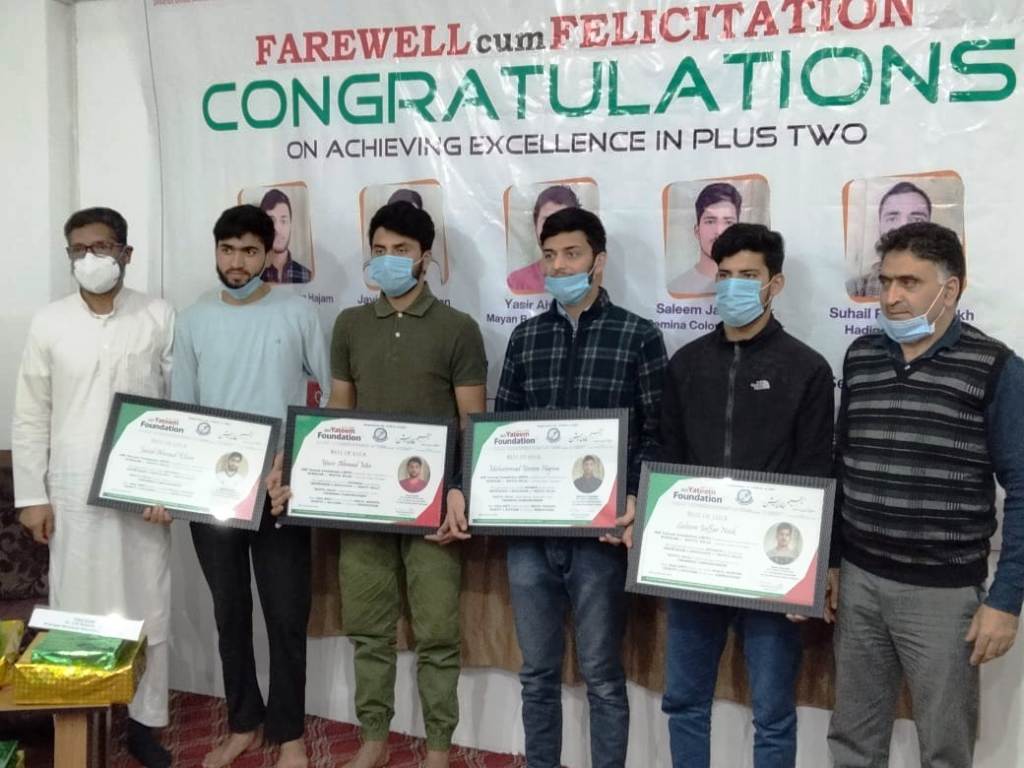
SRINAGAR:  Jammu and Kashmir Yateem Foundation felicitated its PLUS TWO passouts at a solemn farewell cum felicitation function at its Central Office “BAITUL HILAL”, Jawahar Nagar here on Tuesday.

JKYF Felicitates Its Plus Two Pass Outs

Dr S Khurshid ul Islam, Associate Professor, J&K Institute of Management and Public Administration & Rural Development (J &K IMPA & RD) felicitated five alumni of BAITUL HILAL by presenting them Certificates of Excellence on completion of Plus Two courses in different academic streams, a JKYF handout said.

The statement said that senior volunteers and honorary functionaries of JKYF from all districts of Kashmir Division were present on the occasion.

The passouts included Mohammad Yaseen Hajam and Saleem Jaffar Naik from Kishtwar, Javaid Ahmad Khan from Kupwara, Yasir Ahmad Mir from Uri Baramulla and Suhail Rashid Shiekh from Kulgam, it said.

These students had been admitted  over a decade ago at Baitul Hilal.They got their formal education at various private and govt educational institutions in Srinagar, it added.

The statement said that two among the pass-outs have secured admission in BBA at Swami Vivekanand Faculty Of Technology and Management under  Swami Vivekanand Group of Institutes, Punjab. Rest of the pass-outs are awaiting the result of counselling under JEE and NEET.

Speaking on the occasion, Dr Khurshid ul Islam appreciated the achievements of these pass-outs and described their success a unique feat while braving varied difficulties and ups and downs in their life. He stressed the need for a structured career counseling mechanism for the students at JKYF and other such voluntary institutions. Dr Islam urged scholars at BAITUL HILAL and other such children homes to be proactive in seeking best careers while working hard to earn educational scholarships both at national and international levels.

Dr Islam hailed the role and contribution of public welfare institutions including JKYF in facilitating the upbringing and education that helps them to achieve their educational goals. He added that JKYF must focus on health care and education while taking into account the modern requirements and challenges in pursuit of viable careers and socio-economic development of underprivileged sections of society.

Dr Khurshidd ul Islam lauded the efforts of volunteers of JKYF and stressed the need to focus specifically on quality education, vocational training and skill development in order to cope up with th emerging needs and challenges in the present-day world.

Earlier, the outgoing JKYF students shared their experiences of life during their over a decade long stay at Baitul Hilal Srinagar. They also suggested several proposals to improve upon the working at BAITUL HILALs under JKYF at Srinagar, Kulgam, Sopore and Kishtwar.

The students had a free and fair interaction session with the JKYF volunteers and functionaries of JKYF.

Central Executive Committee (CEC) Member, JKYF Abdul Majeed Laway emphasized the need to involve experts in various fields to utilise their expertise in structured career orientation and other activities related to human resource development through voluntary social welfare Institutions like JKYF.

Chairman JKYF Mohammad Ahsan Rather in his vote of thanks expressed gratitude to Dr Islam for encourging JKYF volunteers to take forward welfare mission. He also thanked all volunteers and honorary functionaries of all the districts of Kashmir division for their sincere initiatives and efforts in pursuit of the goal of socio-economic development of underprivileged sections of the society.

The programme started with the recitation of some verses from Holy Qur’an by Saqib Rehman, Class 12th student residing at BAITUL HILAL, Jawahar Nagar.

The proceeding were conducted by Programme Executive Press & PR Javaid Jawad. He threw light on various welfare initiatives and programmes undertaken science 2000.

Pertinently, Dr A H Samoon, Principal Secretary Education, J&K Government couldn’t participate in the farewell cum felicitation due to last-minute pressing official engagements, a JKYF handout said.


from Kashmir Life https://ift.tt/33dEM9C
via IFTTThttps://kashmirlife.net

Shopian Fake Encounter: Bodies Being Exhumed For Burial In Rajouri

SRINAGAR:  Bodies of three youth labourers from Rajouri, who were killed in an “encounter” at Amshipora village of Shopian district by the Army on July 18 and labelled as “militants”, are being handed over to the families “after due process of law”, Inspector General of Police, Kashmir Range, Vijay Kumar said on Wednesday.

Quoting the top police officer news agency GNS reported that the bodies will be exhumed and handed over to families after the due process of law.

The Amshipora ‘Encounter’

Ahmed (25), Imtiyaz Ahmed (20) and Mohammed Ibrar (16) —and immediate arrest along with stern punishment to those behind the killings.

The statement also comes more than a week after army said its high-level Court of Inquiry brought out “certain prima facie evidence indicating that the powers vested under the AFSPA 1990 were exceeded during the operation.”

Defence spokesman Colonel Rajesh Kalia said that inquiry has found that the “Do’s and Don’ts of Chief of Army Staff (COAS) as approved by the Supreme Court have been contravened”.

“Consequently, the competent disciplinary authority has directed to initiate disciplinary proceedings under the Army Act against those found prima-facie answerable,” he had said.

“The evidence collected by the inquiry has prima-facie indicated that the three unidentified (militants) killed in Op Amshipora were Imtiyaz Ahmed, Abrar Ahmed and Mohd Ibrar, who hailed from Rajouri,” he had said, “Their DNA report is awaited. Their involvement with (militants) or related activities is under investigation by the police.”

On July 18, police in a statement had said that three militants were killed in a gunfight with a joint team of police, army and CRPF in Shopian district on input by the army.

“On a specific input by 62RR about the presence of (militants) in village Amshipora area, an operation was launched by them in the area,” a police spokesperson had said.

During the search,  he had said, the militants fired upon Army and encounter started. “Later on police and CRPF also joined. During encounter three unidentified militants were killed,” he had said in the statement, adding, “Bodies of all the killed three (militants) were retrieved from the site of encounter.” However, he had said, the identification and group affiliation of the slain was being ascertained.

Why Shopian Admissions By Army Have Revived Pathribal, Machil Debate?

“Incriminating materials including arms and ammunition were recovered from the site of encounter,” he had said.


from Kashmir Life https://ift.tt/3il8VYR
via IFTTThttps://kashmirlife.net

COVID: GoI Allows 315 J&K Students To Cross Over To Pak To Resume Studies

SRINAGAR: The government of India has allowed 315 students from Jammu and Kashmir enrolled at different colleges across Pakistan to cross over via Attari Wagah border in Amritsar on Wednesday.

In an official communique, a copy of which lies with news agency KNO, the Government of India on request of Pakistan has allowed 315 students to cross over to Pakistan to resume studies.

The government of Pakistan had earlier communicated with the government of India to allow the travel of 315 Kashmiri students to Pakistan on 30th September having Indian passport.

Pakistan had requested that the students be allowed to cross over to Pakistan via Wagah border-attari on September 30.

In reply, the government of India allowed the travel of 315 Kashmiri students to Pakistan on 30th September.

It said, “It is requested that the above mentioned 315 Indian nationalists may be allowed to enter into Pakistan (Subject 5o valid passport) through Wagah border on September 30, 2020, following necessary health security protocol/screening.”

Pertinently, a huge number of students from different parts of Kashmir are enrolled at various Medical Colleges in Pakistan.

It may be recalled that the government of India earlier during the COVID lockdown period made special arrangements for the Kashmiri students for their safe arrival.


from Kashmir Life https://ift.tt/30msDxl
via IFTTThttps://kashmirlife.net

Tuesday, 29 September 2020

With 80,000 New COVID Cases, India Crosses 62 Lakh Mark

SRINAGAR: With a spike of 80,472 coronavirus cases and 1,179 deaths in 24 hours, India’s tally on Wednesday mounted to the grim 62 lakh-mark with a total of 62,25,763 cases.

Out of the total cases, 9,40,441 are currently active, 51,87,825 have been discharged, while 97,497 lost the battle against the viral disease.

While the recovery rate stands at a whooping high of 83.33 per cent, the fatality rate has come down to 1.57 per cent, the data from the Ministry of Health and Family Welfare said.

Maharashtra continues to be the worst-hit with a total of 13,66,129 cases, including 36,181 deaths; followed by Andhra Pradesh, Tamil Nadu and Karnataka.

According to the data from the Indian Council of Medical Research (ICMR), India conducted 10,86,688 sample tests in a single day on Tuesday, taking the total number of samples tested so far to 7,41,96,729. (IANS


from Kashmir Life https://ift.tt/3kX4Xri
via IFTTThttps://kashmirlife.net

‘Unlike Earlier Relief Packages, This One Doesn’t Defer But Reduces The Interest Burden Of Borrowers’

The shutdown of 2019 was followed by the pandemic lockdown and it has created a crisis for the economic wellbeing. It was in this backdrop that the Jammu and Kashmir administration announced an economic package. In this interview, economist Dr Haseeb A Drabu, the former Finance Minister of the erstwhile state, offers ideas about how the policymakers must intervene to prevent the crises getting unmanageable and how to gradually help the growth sustain the economic activity

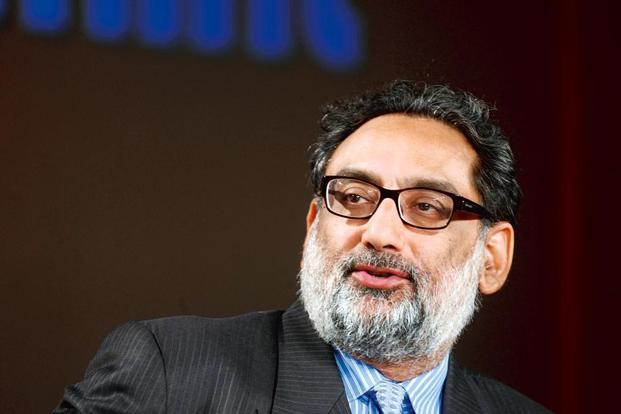
Haseeb Drabu

KASHMIR LIFE (KL): Jammu and Kashmir administration announced Rs 1,350 crore package last week. What is this intervention all about?

HASEEB A DRABU (HAD): It is a good package. In fact, if you were to consider how the Government of India has handled the economic impact of the pandemic in the country, it is an excellent one. From among the state governments, in my opinion, it is next only to that of the Government of Kerala. The Kerala government policies have a better redistributive component than the Jammu and Kashmir package.

Compared to other economies Kashmir doesn’t have a serious incidence of structural unemployment. What we do have is a severe issue of under-employment. The conversion of under-employment into unemployment will need to be addressed.

KL: The erstwhile state has had much bigger packages – one even Rs 80,000 crore. So how can this be of help Jammu and Kashmir?

HAD: Those were rehabilitation and reconstruction packages. This is a relief package. Hence the two are not comparable. If you look at it closely, it is a one-point package; interest relief. Out of the Rs 1,350 crore, Rs 950 crore is in the form of interest subvention. Of the remaining, Rs 400 crore, about Rs 100 crore has been given as relief on electricity and water charges to commercial and industrial power consumer and the rest is recycling earlier initiatives.

But as I said, the interest relief is significant. The most important part of the package is that unlike any other interest relief package this one doesn’t defer the burden of borrowers, it actually reduces the interest burden of the standard borrowers. Actually, it is effectively an interest rate reduction of 500 basis points for one year for the Jammu and Kashmir borrowers. On this front, I don’t think more could not have been done.

It will not provide any relief to the impaired accounts. While this is the right thing to do, the fact is that there are a lot of stressed and sub-standard accounts who also need to be helped.

Much will, however, depend on how it is implemented by the Bank. There is need to issue uniform procedural guidelines and not left to the discretion of individual bank managers.

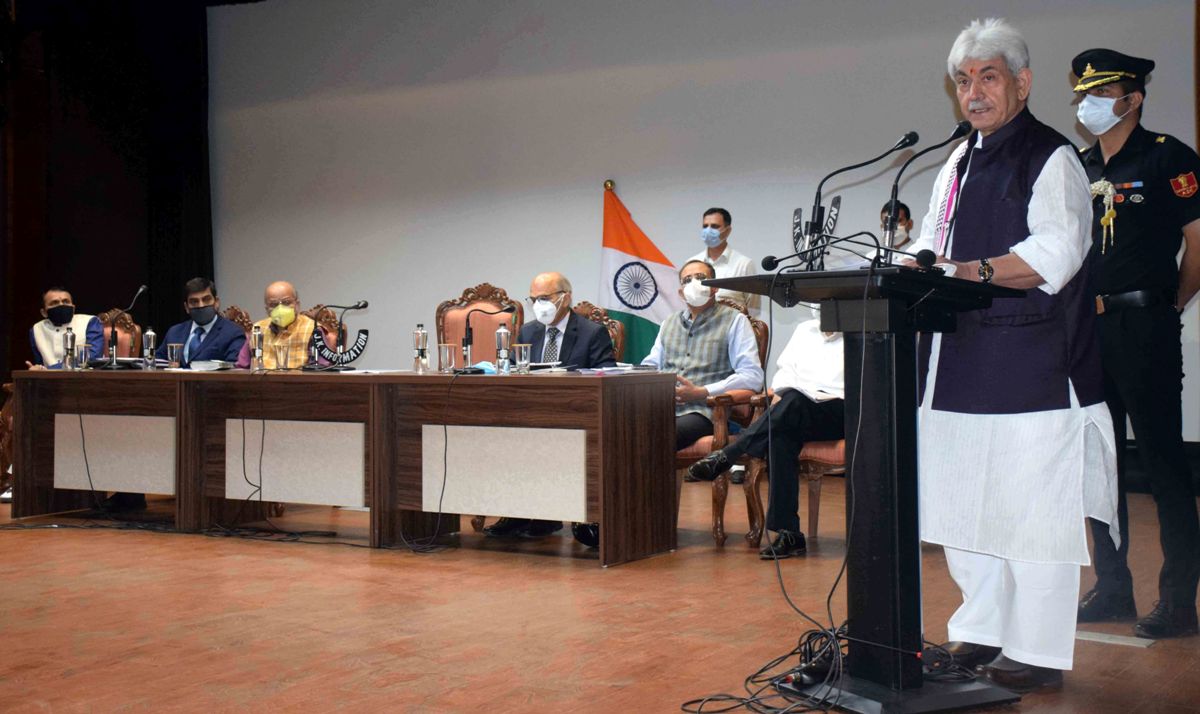
Lieutenant Governor of Jammu and Kashmir Manoj Sinha addressing a press conference in Srinagar over economic package on Saturday, September 19, 2020. KL Image by Bilal Bahadur

KL: This package did not create a fair balance between a person who is indebted to bank and to a farmer, who had no loan even though both suffered since August 2019?

HAD: That is a key issue. It is a relief only for the bank borrowers. And a breather for the Jammu and Kashmir Bank! So it is not a package for the people but for the business and economy. It is hoped that with this relief, trade and commerce will pull through these difficult times and ensure some economic activity so that the process of income generation in the economy starts and trickles down to the lower strata of people who are the worst affected both in terms of life and livelihood; the workers, the casual employee, the farmhand, the artisan; basically the informal sector which is the backbone of the economy of Kashmir.

It will not provide any relief to the impaired accounts. While this is the right thing to do, the fact is that there are a lot of stressed and sub-standard accounts who also need to be helped.

KL: Given the costs that the situation exacted from Kashmir economy, what are the key stress points in the Kashmir economy?

HAD: The lockdown and the pandemic impaired not only the economic growth but also impacted the income distribution and poverty. While historically, the economy of Kashmir has had low levels of poverty compared to the all-India average, when we look at urban poverty, it is higher than rural poverty. We do not have a problem of rural poverty because of land reforms in the 1950s and commercialisation of agriculture in the 1970s. However, we have issues of urban poverty. This pandemic is having a much greater impact on urban poverty.

While we don’t have issues of absolute poverty, we have a serious issue of income inequalities. The income inequality will widen considerably even as immiseration of the urban masses will happen.  This needs to be addressed through direct policy intervention because most of these people are not bank borrowers. So it doesn’t change anything for them.

KL: What can be done to alleviate this?

HAD: If you recollect the Jammu and Kashmir Budget of 2017-18 had tried to address the issue of urban poverty. I had set out to create a social security system for all the construction workers in the state. The most important element of the social security system for this section of the working class is to ensure the availability of a small corpus of money for meeting emergent and urgent basic household or familial needs. This will help them survive the pandemic even as it will have a positive multiplier effect in the economy.

As Minister for Labour, I had initiated Cash Credit Facility up to Rs 10,000 at one-year MCLR for every registered construction worker, with in-built comprehensive insurance – covering life, health and accidental insurance. For these, all the three premiums were to be paid by the Jammu and Kashmir Constructions Labourers Board on behalf of the workers. Something of that kind needs to be done. The distress in urban Kashmir is mounting.

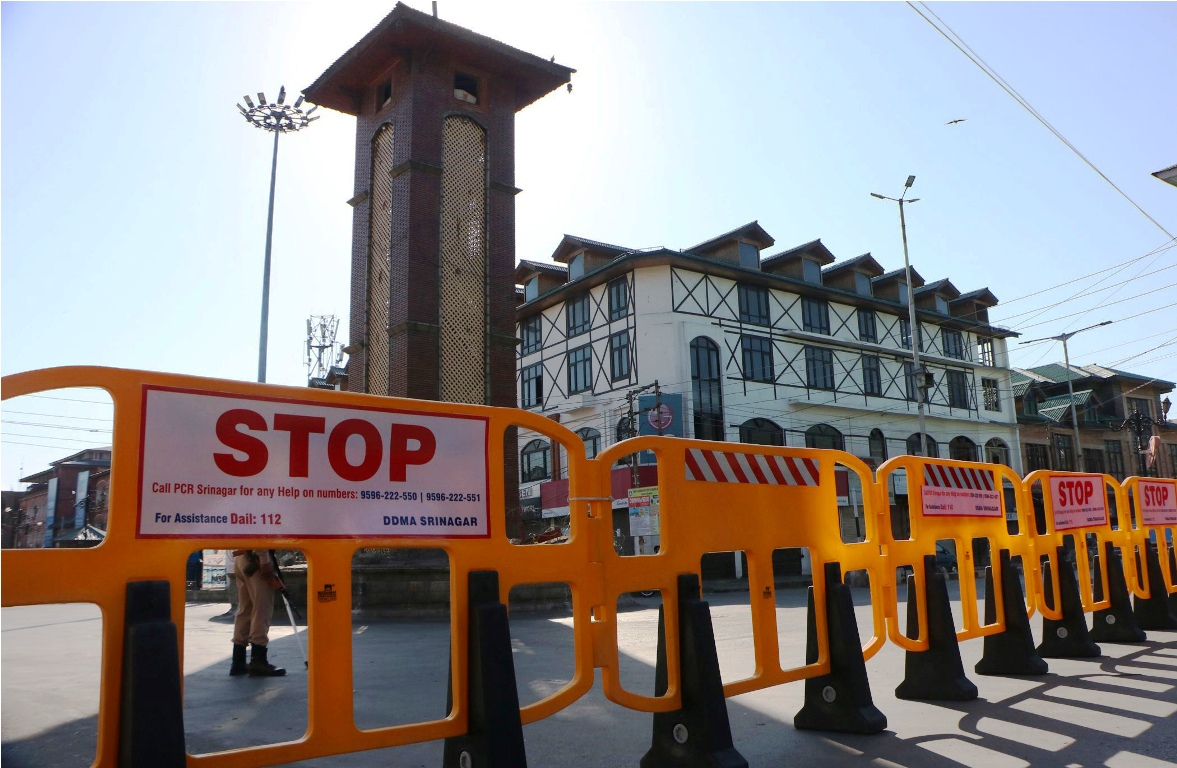
Lal Chowk, the heart of Srinagar on July 13, 2020, when the second phase of lockdown started for containing the Covid-19. KL Image: Bilal Bahadur

And also to make sure that the rural area is insulated from distress, this is the time to ensure that the horticultural sector is helped in realising the value of their produce and protecting their margins. There is a collapse of national demand. So, I would suggest that costs of packaging and transportation should be reduced. This will protect their margins and incomes. A package for transport relief needs to be worked out.

This is especially important as after the clampdown in August, trade links have been badly disrupted and business networks are in disarray. Business confidence has been shaken. This has resulted in the shrinking of the regular trade cycle of supplier’s credit. This in turn has forced the trade, especially the wholesalers, to exhaust their working capital lines/ cash credit lines making the businesses illiquid.

As regards the crafts segment, the urgent need is to monetise the inventories that are piled up and the cost of carry is high. Some of the cost of carry for larger players will get reduced because of the interest burden. For the small and medium players, there has to be a way to free their capital that is locked up in the form of inventories in the showrooms, shops and workshops. Today, they have inventories that can neither be liquidated nor monetised. The businesses have assets that they can’t sweat because of demand disruptions; they can’t leverage them because of credit limits having run out.

The Government can act like a buyer of crafts through its undertaking and buy out all the inventory of carpets and other handicrafts. It will not cost more than Rs 200 to 300 crore. They can hold these inventories for two years and then either do a buyback when the situation improves or sell it when the going is good. It will not only regenerate the crafts economy but will also give a fillip to income generation.

KL: How will the falling GDP across India impact Jammu and Kashmir in the coming days?

HAD: Very adversely. Kashmir is not new to lockdowns. Before the pandemic, 2019, the valley has been under a lockdown. But at that point, goods and services produced by the local entrepreneurs could be sold in the national markets, right across the country. Today that option has shrunk because of the pandemic. The national markets have been shut or operating at 10 per cent capacity. Demand has collapsed. There has been a massive income shock. And what Kashmir exports, are essentially luxury items like carpets and shawls. Or non-essentials like apples. That is always residual demand. When incomes falls, aggregate demand drops, it is the residual demand that is first to be impacted. So Kashmir economy will face a severe shortage in demand.

We don’t have a problem of rural poverty, we have an issue of urban poverty. This pandemic is having a much greater impact on urban poverty. The income inequality will widen considerably even as immiseration of the urban masses will happen.  This needs to be addressed through direct policy intervention because most of these people are not bank borrowers.  

KL: What will happen to employment?

HAD: Compared to other state economies and even in comparison with the all-India level, Kashmir doesn’t have a serious incidence of structural unemployment. What we do have is a severe issue of under-employment. The high incidence of under-employment will now show itself up in terms of an increased level of unemployment. In our economy, we have less of wage employment outside government and more of self-employment. In Jammu and Kashmir, we have either government employment or self-employment. There is hardly any private sector employment. Given the already very high levels of government employment, there is a need to regenerate self-employment.

KL: What is the state of the banking sector in India and how Jammu and Kashmir Bank is going to be impacted in coming days?

HAD: This is perhaps the worst period for the banking sector in India that I have ever seen. There are huge issues about the asset quality of banks and the credit lines are getting severely chocked because of regulatory norms that have been designed for a steady state economy. Today there is a crisis and no one is looking at changing the prudential norms. Jammu and Kashmir Bank is facing the same issues and more. But, this package will give them a breather. In that sense, this package is good for businesses and banks!


from Kashmir Life https://ift.tt/30n1uKS
via IFTTThttps://kashmirlife.net

Abdul Samad 3rd J&K Cricketer To Play In IPL, Hits Huge Six On His Debut

by Khalid Bashir Gura

SRINAGAR: The fans of Sunrisers Hyderabad may have been disappointed when the opener Bairstow was dismissed by Rabada on the fifth ball of the seventeenth over but for the people of J&K eureka moment came in as at number five, J&K’s Abdul Samad walked into the ground. The J&K star was coming off a breakout the domestic season during which he scored two Ranji Trophy centuries.

Abdul Samad IPL

J&K’s right-handed batsman Abdul Samad came to the crease. It was a huge moment for young Samad who is known for his power-hitting prowess. A moment had come for the boy to realize his dreams and showcase his abilities as his team Sunrisers Hyderabad desperately needed a power-hitter down the order.

The very first ball Abdul Samad had to face was of the fast bowler Nortje. It was after 18.1 overs that he got to face the first ball. The captain of the 2019 New Zealand world cup match, Williamson was his partner on the other side. The ball was full and straight and Samad slogged but got it off the inside half towards mid-wicket.

Samad’s IPL career is off and he is running for the first run.

The next ball he faced without scoring a run. It was there in the slot but Samad who was a fraction late due to Nortje’s extra pace failed to connect.

The next ball had relief in store for the debutant. The bowl got top-edge and went straight to the fence.  Four! It was an attempted swipe across the line by Samad but young Samad was again late. The bowl sliced over the wicketkeeper, very fine down to third man fence.

And then the moment came when the jittery fans had a moment of euphoria! The fists were banged and high fives were shared. ( Though not on the ground were automated crowd on speakers cheered for him as stands were empty due to Covid-19 protocol.)

Abdul Samad got hold of the last ball of the 19th over. He displayed his first signs of abilities by hitting Six. The bowl was in the slot and he pounced on it and pumped it high over the wide long-on. It went high, high and high and landed in empty stands.

His teammates applauded as he helped them inch towards victory.

The six set the standard as doing against a bowler of Nortje’s pace shows that the boy from J&K has a talent for sure said the commentator.

As his team; Sunrises Hyderabad won the match, Abdul Samad, 18, who belongs to Kala Kot of Jammu and Kashmir remained not out. He faced seven balls and scored 12 runs in his Debut match with a strike rate of 171. 43.

The delirious English commentator put it on television: “Has he got it? The youngster from Kashmir has got hold of it and it has got back to Kashmir. Booom!”

Earlier, SRH had handed a debut to Jammu and Kashmir’s 18-year-old all-rounder Abdul Samad against the Delhi Capitals.  He became the third cricketer from the valley to play in the Indian Premier League.

Hyderabad had made two changes in the playing eleven, Kane Williamson made his way back into the team by replacing Mohammed Nabi and Abdul Samad replaced Wriddhiman Saha.

Samad caught the eyes of former Indian pace bowler Irfan Pathan when he was playing at a camp organised for the state Ranji Trophy team. Pathan saw how this youngster was playing way better than other experienced players. Samad made his Twenty20 debut for Jammu & Kashmir in the 2018–19 Syed Mushtaq Ali Trophy in February 2019 and that was followed by his List A and First-Class debut in the same year.

Samad scored a whopping 592 runs including 36 sixes he hit – the most by anyone in the season – that eventually led to J&K making it to the quarter-finals of the Ranji Trophy

Manzoor Dar, Rasikh Salam and Parvez Rasool are the other three cricketers from Jammu and Kashmir to have been a part of the Indian Premier League. While Salam got a game of Mumbai Indians, Rasool was a regular feature of the Pune Warriors India franchise. Dar, part of KXIP, never got a game.

The former chief minister of Jammu and Kashmir Omar Abdullah took to Twitter and expressed elation at Abdul Samad’s debut.  “So good to see another youngster from J&K get his IPL cap. #AbdulSamad got his @SunRisers cap this evening. Here’s hoping his career goes from strength to strength,” tweeted the tech-savvy Omar.

Expressing good wishes and prayers for the Abdul Samad, PDP youth president, Waheed Ur Rehman Parra also took to Twitter and wrote: “Promising player, passionate about the game and a hard worker. Our best wishes! Rise and shine.”


from Kashmir Life https://ift.tt/2GjrCis
via IFTTThttps://kashmirlife.net