by Masood Hussain
SRINAGAR: More than 600 years after his death, Hafiz Shirazi, one of Persia’s most celebrated poets has made a grand return to Central Asia. One of his poems sung by various Asian singers befits the current global situation and is creating waves on social media, in the subcontinent and in Central Asian countries.
Shehr Khali describes the desertion of the world and laments the loss of life, the disappearance of the love and emergence of a situation in which the doctors are scared of treating the sick. It is not known that in which context the fourteenth-century poet has written this poem but there cannot be any strong expression of the current situation in any other poetic work as it has.
It aptly describes the global predicament:
Oh, woe to the world where lovers fear one another,
Where thirsty buds fear gardens,
Where lovers fear the sound of the union,
Where hands of musicians fear instruments,
Where the chevaliers fear flat roads,
Where doctors gear the sight of the patients.
Read the full poem and understand the pain and the perfect representation of the twenty-first-century world.
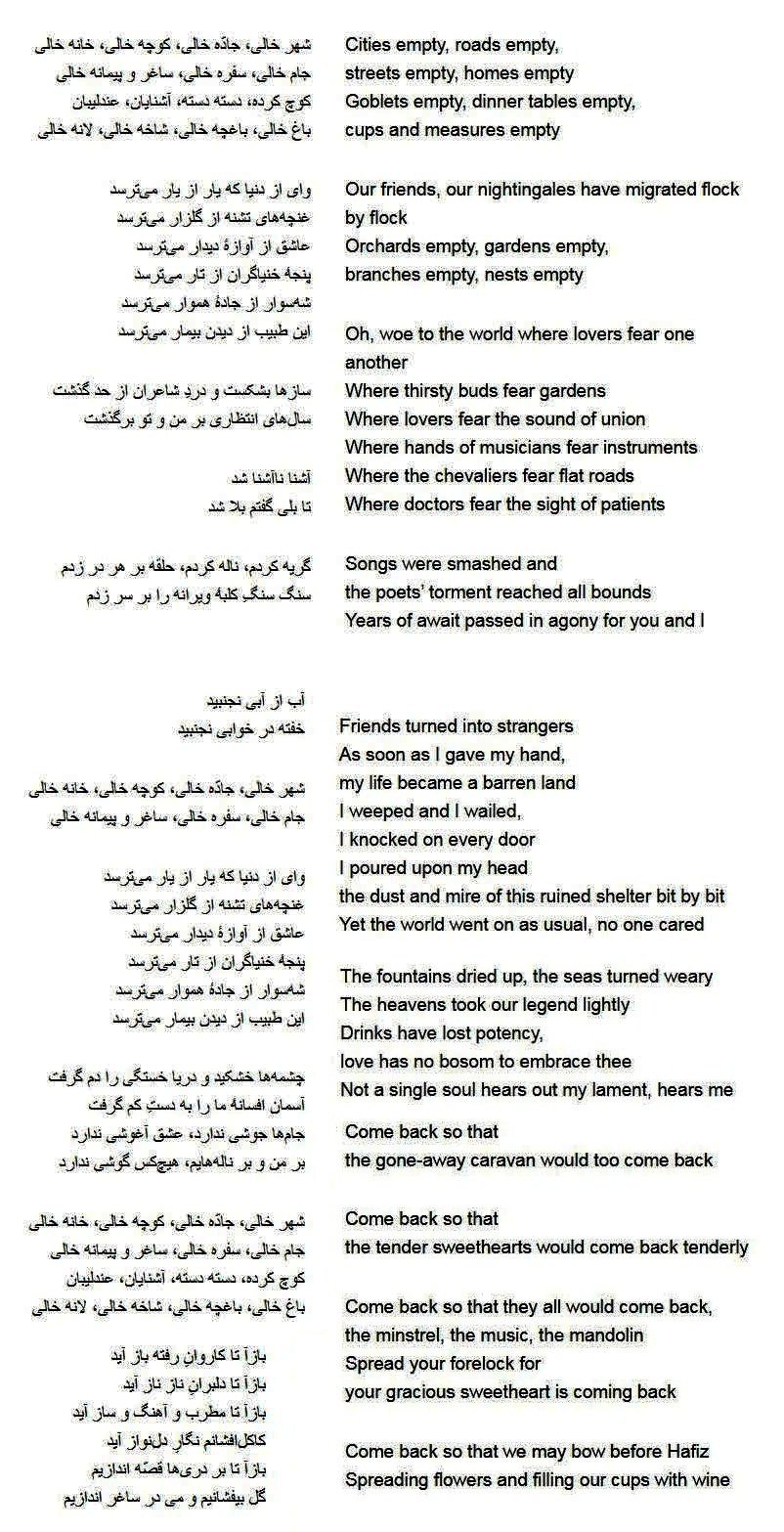
The Persian to English transition of the famous poem by Hafiz Shirazi.
Hafiz Shirazi

Fourteenth century Persian poet, Hafiz Shirazi. A painting by Abolhassan Sadighi
Hafiz, whose real name was Khwaja Shams-ud-Din Muḥammad Ḥafeẓ, is one of the most renowned Persian poets whose creations are considered immortal. A person who had memorized the Quran in his childhood had started his writing poetry quite early in life. His fame grew across the Muslim world as the successive regimes patronised him. He did expose the clergy’s hypocrisy while lauding the love. He died at the age of 75 in 1390. His popularity, however, has not faded even though Iran produced bigger stalwarts in Persian art and literature.
However, Hafiz’s rediscovery for the commoners in twenty-first-century owes to two singers – one in Afghanistan and another in Tajikistan. Interestingly, they have sung the poem much earlier and might be oblivious of their relevance in the contemporary situation.
Amir Jan Sabori
The poem was sung by Afghanistan singer Amir Jan Sabori in the past. Sabori is from Herat province of Afghanistan. The poem might have appealed him because Afghanistan has been in a particular situation for a very long time.
Almost nine years back, the same song was sung by Tajikistan’s teenage singer, Nigora Kholova. After she choose to be a professional singer, she sang it again and the number became very popular. Sharing borders with Afghanistan, Tajikistan has strong cultural influences. The Tajik language is hugely laced with Persian.
But the people outside the two countries discovered the song quite recently when somebody in the frontier province translated the lyrics into Urdu and superimposed the current motion pictures and made the video relevant to the contemporary situation that got it a vast audience. In the last two weeks, there are multiple variants of the song available.
Nagora Kholava
What is magical is Nogora’s voice that adds an element of pathos to the lyrics. Nothing much is known about the Tajik singer though she has a lot of fan following on the social media. Open source details suggest the 1989 born singer is the daughter of an artist who started singing at a very early age. She has, however, been to concerts in Herat.
Crisis Everywhere
What is more interesting is that the Coronavirus pandemic has engulfed all the countries related to the poem and the singers– Iran, Afghanistan, Pakistan though Tajikistan is offering a different narrative.
Iran, where the poet rests in the magnificent memorial at Shiraz, had emerged as the second hotbed of the virus after China’s Wuhan. By now, it has lost almost 3900 people while around 32000 are gasping for breath. What makes it more interesting is that while Hafiz’s liberal Persia now follows the Sharia law and is facing serious hardships because of the sanctions. It has not been able to source proper medicines or the personal protection gear for its healthcare workers from abroad because of the sanctions.

Tajikistan singer, Nagora Khlova
Afghanistan, its immediate neighbour where Sabori got it out of Devan-e-Hafiz, has lost 15 individuals to the disease as almost 300 are struggling to survive. Interestingly, Sabori’s Herat home has the highest number of Covid-19 cases. A general impression is that the country trying to come out of the political crisis is not ready to fight the pandemic. The country got its first case from Qom in Iran – exactly on Ladakh pattern, wherefrom a resident had returned from pilgrimage. Now, more than 130 thousands Afghan residents have returned from pandemic hit Iran. Most of them are refugees who also work in Iran as well. This has added to the risk of the community spread. In mid March as many as 37 Covid-19 cases had fled from a Herat hospital adding to the fears of the people.
Nigora’s home, Tajikistan, however, is an interesting country as far as the Covid-19 goes. It is one of the dozen -odd countries with North Korea that have no reported of the pandemic. The country had earlier closed the mosques but has reopened. It is trying to show the life as usual as the local football league matches also started yesterday. Earlier, it had blocked the entry of travellers from various pandemic hit countries but the orders were soon reversed. World media has reported that the government is telling people not to give any credence to rumours of the epidemic. “The Coronavirus is not discussed in schools and universities, despite reader comments online describing school classrooms full of coughing students,” one report in an international media said.
The Powerful Voice
That does not, however, negate the Tajik singer’s voice that helped Hafiz to reach millions, many centuries after his death. One of the interesting anecdotes about Hafiz was that he once, in a ghazal, offered Bukhara and Samarkand for the mole of his beloved cheek. This angered the king Timur, who said that by the power of his sword to expand the empire and a pitiful poet is trying to give tow cities for a women’s mole. Quick-witted Hafiz responded: “O Sovereign of the world, it is by the state of similar generosity that I have been reduced, as you see my present state of poverty.” He got gifts instead.
Pertinently, Persian was Kashmir’s (and to major Muslim belts in the Indian subcontinent) court language till Urdu took over later in the nineteenth century. Since the Urdu as heavily borrowed from the Persian language so the Hindustani speaking people do not misunderstand Hafiz, unlike Timur. The poem explains’ current crisis the best.
from Kashmir Life https://ift.tt/2Riu37y
via IFTTThttps://kashmirlife.net


No comments:
Post a Comment